
Name, characteristics and scope
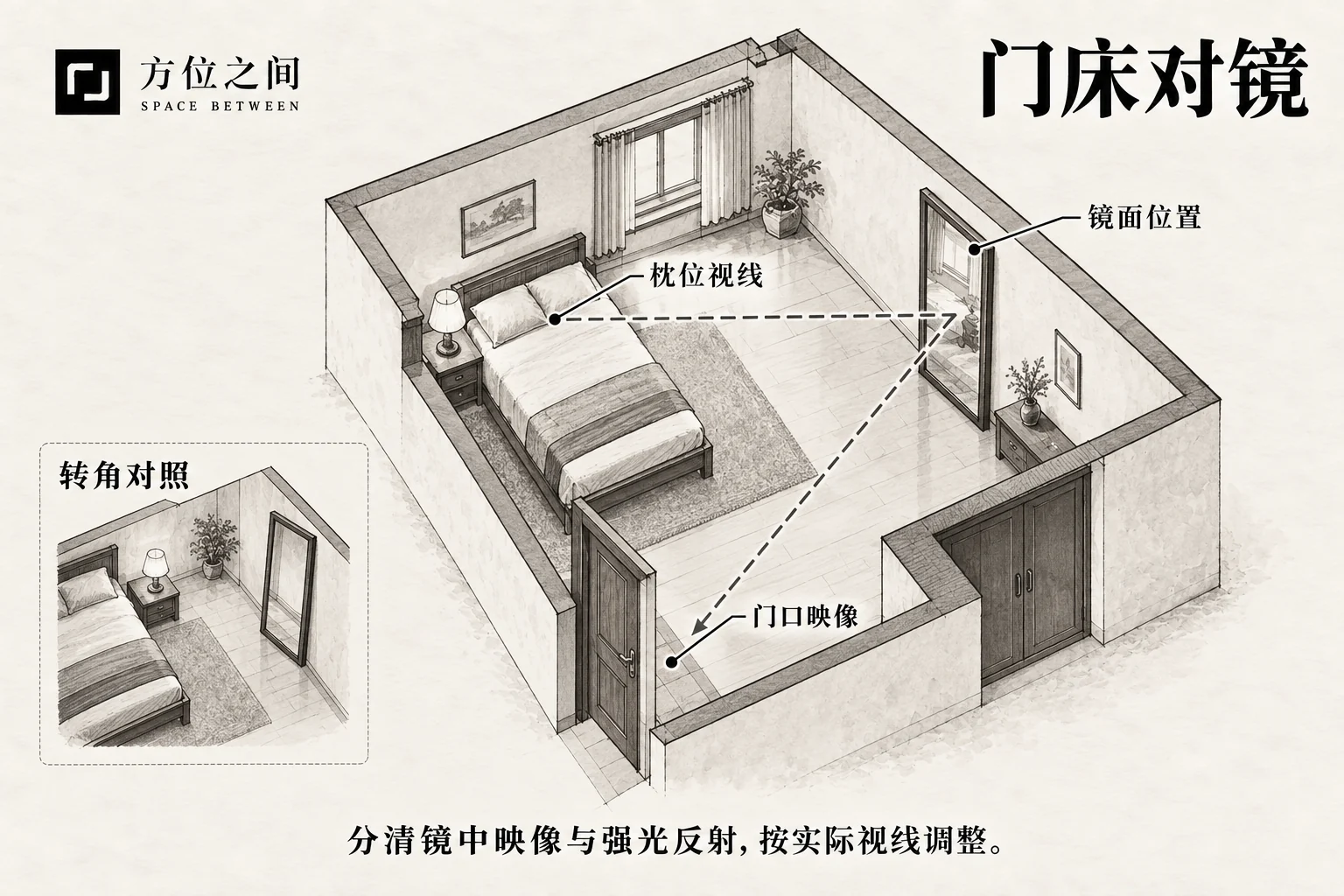
A mirror facing a door or bed reflects that opening or bed. Mirror sha is a broader label that may refer to glare, repeated images or uncomfortable placement. A mirror does not automatically emit a special force because it faces a bed. Distinguish seeing the bed in the mirror, reflected light reaching the eyes and discomfort from nighttime images.
How to identify it step by step
Start from the position people actually use, recording shape, spatial relationship and duration separately. These checks distinguish conditions; they are not a universal formula for fortune.
- Check reflected objects from lying, seated and entrance viewing heights.
- Observe in daylight, with lights on and in dim nighttime light, recording any glaring bright spots.
- Check secure fixing, exposed edges and whether the mirror lies within a door's collision range.
- Temporarily cover the mirror and compare the experience. A single fright does not establish a long-term effect.
How to understand the folk account
Traditional interpretations build ideas of reflection, directed influence or disturbed sleep around mirrors. Some schools also use mirrors as remedies, so a universal rule that mirrors are harmful is not consistent. Placement does not establish marriage, disease or affair predictions; discuss light and psychological experience separately.
What matters in present-day living
Reflection changes where light falls, but glare depends on the source, mirror angle and observer. Mirrors can also make a space feel larger, with differing personal responses. Treat optics, glass fixing and personal preference as separate matters.
Traditional responses and practical adjustments
Traditional ideas of avoiding, screening, buffering and separating can be understood as reorganizing sightlines, circulation and activity areas. Try small reversible changes first, then consider permanent alterations if they help.
- Rotate or move the mirror so strong reflections leave frequently occupied sightlines.
- Use a cabinet door, curtain or partial cover when needed to reduce nighttime images.
- Choose appropriate fixing and keep the mirror clear of moving doors and furniture.
- Do not routinely aim bagua mirrors or large mirrors at neighbors, where reflections may cause disturbance and conflict.
Common misreadings and related names
A doorway visible in a mirror differs from directly facing doors; draw the reflection path for the former.
Many mirrors do not inevitably cause insomnia. Without discomfort or problematic reflection, quantity alone is not a reason to remove them.
Sources and further reading
These sources help clarify the concepts and their origins. Explaining a traditional term does not establish that it can predict outcomes.