
Name, characteristics and scope
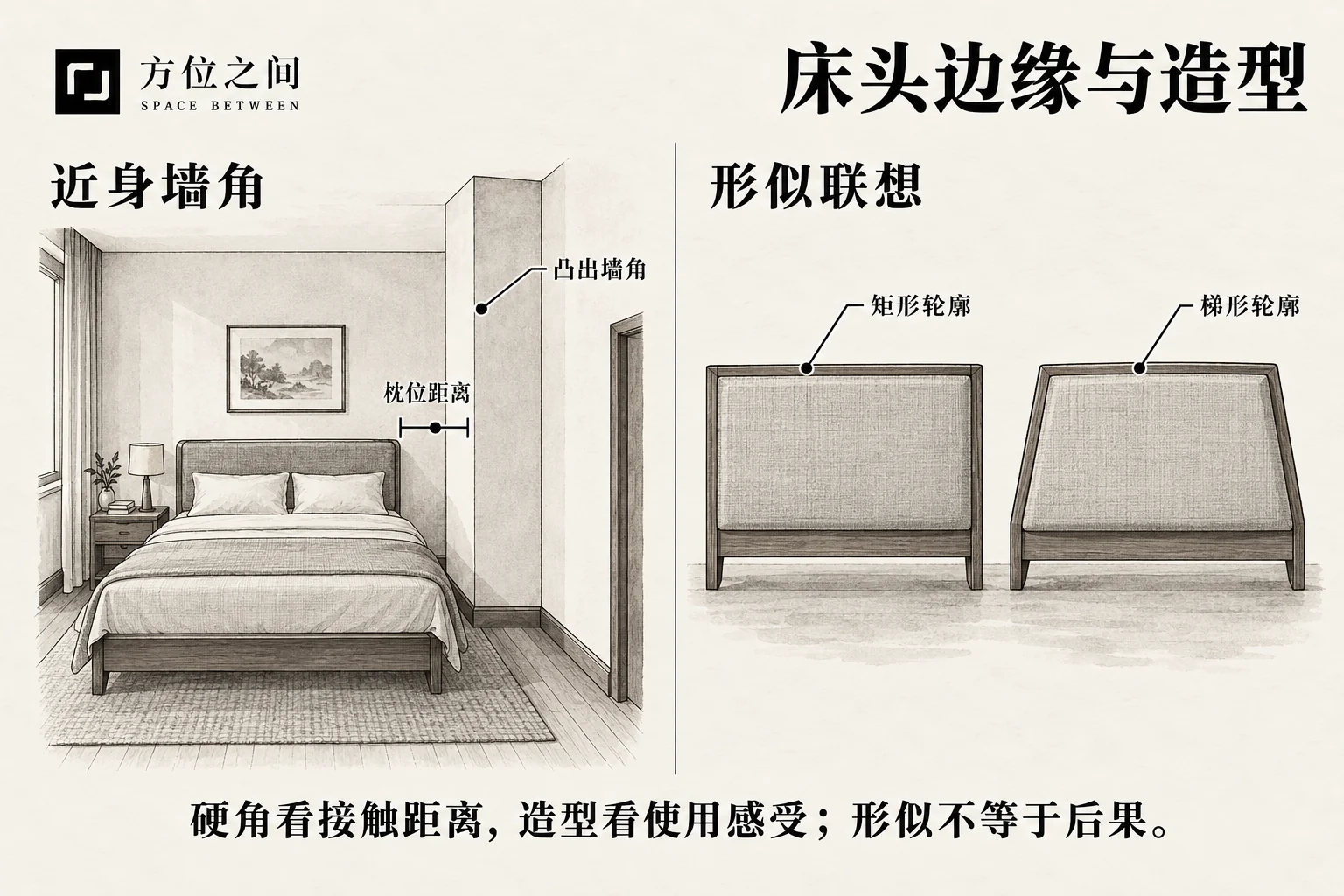
A bedhead wall blade usually means a wall end, projecting column or sharp vertical edge directed toward the pillow. In indoor writing, coffin sha may instead mean a headboard or bed resembling a coffin: a visual association, not the same spatial problem. The former allows measurement of an edge and distance; the latter requires identifying a trapezoid outline, enclosure or personal reaction to the design.
How to identify it step by step
Start from the position people actually use, recording shape, spatial relationship and duration separately. These checks distinguish conditions; they are not a universal formula for fortune.
- Photograph corners and columns from the pillow. Determine whether they only appear aligned at a distance or are close when rising.
- Check the headboard's actual outline, projections and fixing rather than imagining its shape from a name.
- Simulate getting in and out, changing sheets and walking at night to locate hard corners that may be struck.
- Ask whether actual light and shadow, crowding or symbolic associations trouble the occupant; do not decide on their behalf.
How to understand the folk account
The blade metaphor expresses unease through sharpness; the coffin metaphor draws on resemblance and funerary taboos. Neither supports predictions of illness, injury or lifespan. A cultural preference about resemblance deserves respect without claiming that a particular form inevitably harms people.
What matters in present-day living
Practical priorities are contact with hard corners, headboard stability, cleaning clearance and visual comfort. If a column cannot readily move, shifting the bed, cushioning contact edges or changing lighting is more feasible than removing the column. A persistently uncomfortable headboard design can also be replaced without an explanation based on fate.
Traditional responses and practical adjustments
Traditional ideas of avoiding, screening, buffering and separating can be understood as reorganizing sightlines, circulation and activity areas. Try small reversible changes first, then consider permanent alterations if they help.
- Shift the bed or pillow away from places where actual collisions are likely.
- Treat accessible sharp edges with suitable, secure and cleanable protection.
- Avoid heavy ornaments above the bedhead where they could fall.
- Do not cut or remove load-bearing walls, columns or beams because they are called a wall blade.
Common misreadings and related names
A distant wall-line projection differs from a nearby hard corner; do not mix observation scales.
Other sources may use coffin sha for an entire building. This entry discusses only the headboard context.
Sources and further reading
These sources help clarify the concepts and their origins. Explaining a traditional term does not establish that it can predict outcomes.