
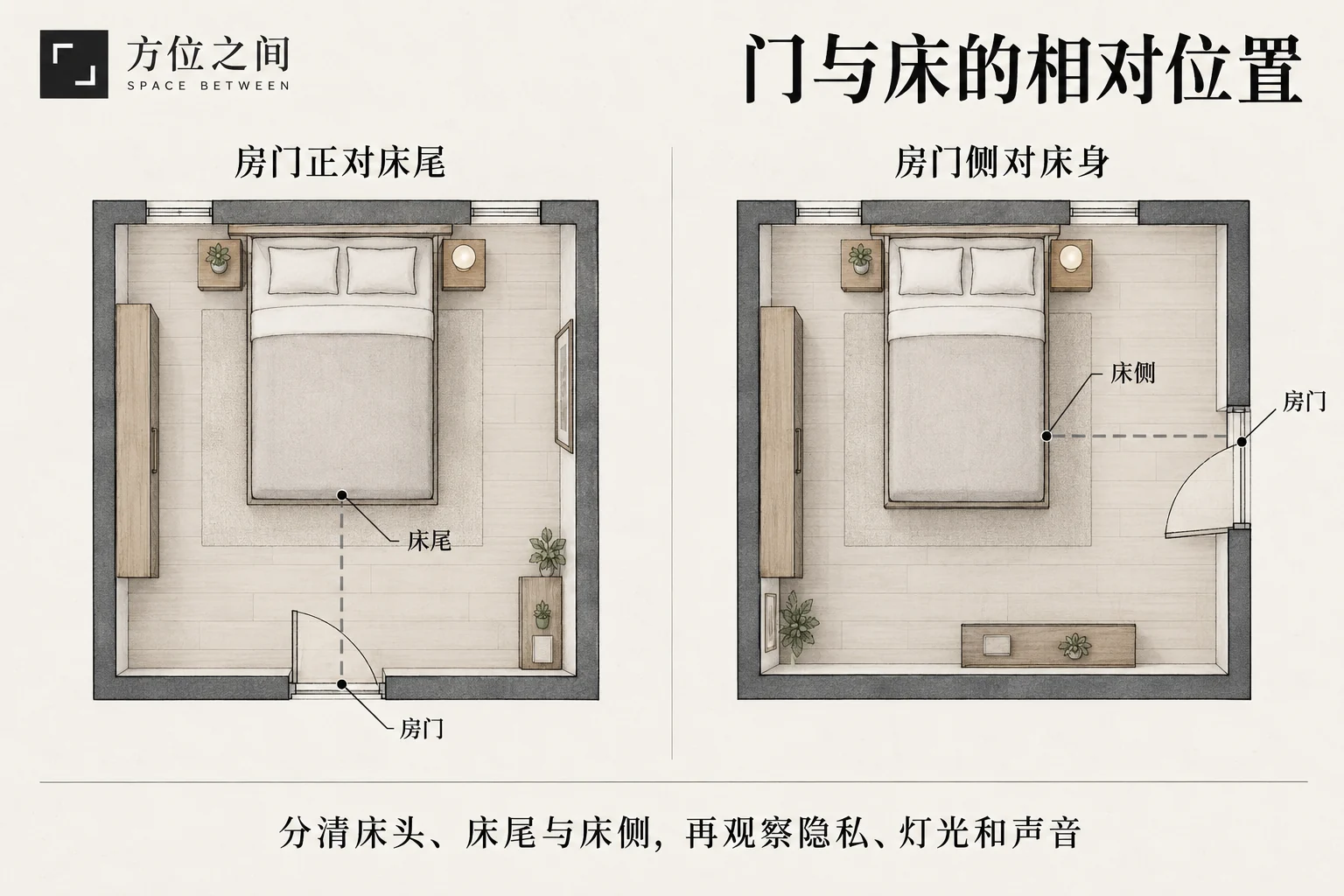
Name, characteristics and scope
Door-bed alignment means the bed is directly visible through a doorway or the doorway points toward the bed's side. Facing the head, foot or side are different layouts, and bedroom and bathroom doors have different contexts. Bedroom sha is a broad umbrella: identify the door, toilet, corner or light involved instead of treating it as one fixed shape.
How to identify it step by step
Start from the position people actually use, recording shape, spatial relationship and duration separately. These checks distinguish conditions; they are not a universal formula for fortune.
- Draw the doorway and bed to their actual sizes, distinguishing alignment with the head, foot or side.
- Observe from sitting and lying positions on the bed to confirm what someone opening the door can see.
- Record whether nighttime door movements, corridor lights or footsteps disturb rest.
- If a bathroom door faces the bed, also check moisture, ventilation and sound, rather than drawing only one connecting line.
How to understand the folk account
Folk explanations emphasize a quiet, sheltered sleeping space, then extend this to hostile people, romantic affairs or fluctuating fortune. These associations may be discussed as culture, but a bed facing a door does not establish loyalty, health or relationships. Nor is there a generally accepted lucky distance between bed and door.
What matters in present-day living
Privacy, intrusive light, door noise and circulation usually deserve attention. Side alignment is not necessarily worse than frontal alignment; access to the bed, household routines and room size matter. Forcing the bed into a dark, cramped corner may simply introduce new problems.
Traditional responses and practical adjustments
Traditional ideas of avoiding, screening, buffering and separating can be understood as reorganizing sightlines, circulation and activity areas. Try small reversible changes first, then consider permanent alterations if they help.
- Adjust the bed or the entrance sightline so circulation need not pass close to the pillow.
- Improve privacy with a light curtain, partial screening or furniture orientation without sealing necessary ventilation.
- Address directly observable disturbances such as collisions, nighttime lighting and door-closing noise.
- Keep bedside access and cleaning space, and ensure furniture remains stable when secured.
Common misreadings and related names
A mirror reflecting the door and bed involves reflection and should be observed separately from a door directly facing a bed.
A bathroom facing a bed calls for moisture and extraction checks. Closing its door or adding symbolic objects cannot be claimed to solve everything.
Sources and further reading
These sources help clarify the concepts and their origins. Explaining a traditional term does not establish that it can predict outcomes.