
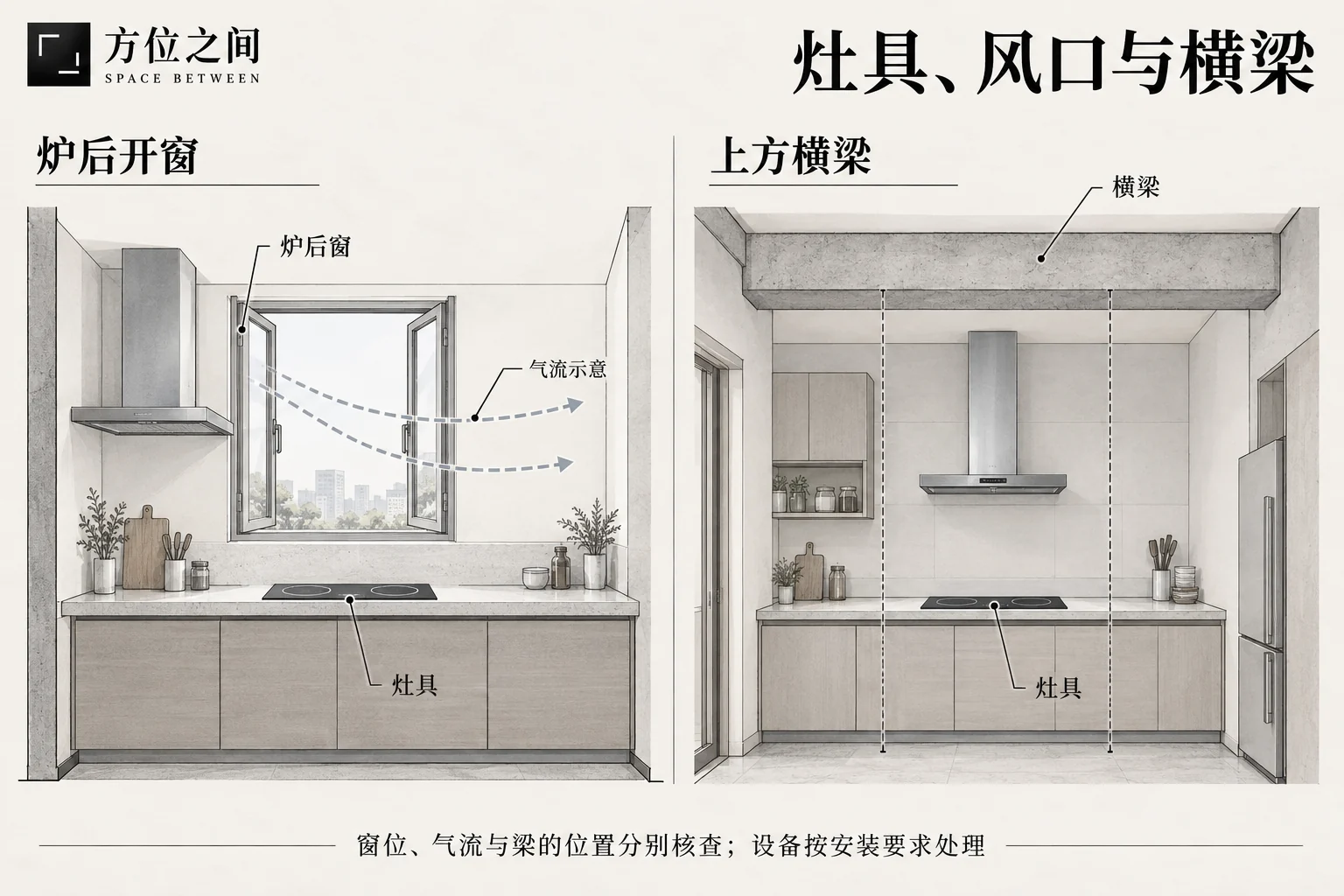
Name, characteristics and scope
These three descriptions concern airflow paths, window position and overhead components respectively. A stove facing a vent concerns possible air movement through the work area; a rear window concerns the opening behind the counter; a beam over a stove concerns overlapping vertical projections. All may coexist, but one financial-loss explanation cannot replace their separate checks.
How to identify it step by step
Start from the position people actually use, recording shape, spatial relationship and duration separately. These checks distinguish conditions; they are not a universal formula for fortune.
- Distinguish gas, induction and other appliances. The same flame-based reasoning does not apply to every type.
- Record windows, doors, extraction and supply vents. Observe normal use; do not deliberately create strong wind to test a flame.
- Identify whether the overhead feature is a structural beam, decorative casing or cabinet edge, and record maintenance access.
- Check installation requirements for extraction, the stove and surrounding materials.
How to understand the folk account
Folk tradition treats the hearth as a source of nourishment, associating an open rear, wind and overhead pressure with unstable resources. Relationships between windows and beams do not establish predictions about wealth or family relations. Concern for a heat source and work area can remain part of the cultural explanation, provided the actual inspection objects are clear.
What matters in present-day living
Overhead components may affect equipment placement, cleaning or feelings of confinement; windows can affect extraction and habits. Assess safety through appliance instructions and professional evaluation rather than inferring structural or combustion danger solely from the label beam over stove.
Traditional responses and practical adjustments
Traditional ideas of avoiding, screening, buffering and separating can be understood as reorganizing sightlines, circulation and activity areas. Try small reversible changes first, then consider permanent alterations if they help.
- Plan ventilation together with extraction and equipment requirements, without screens obstructing normal use.
- Follow installation instructions for distances and fixing between stove and extraction equipment.
- Adjust lighting, cabinetry or working position to reduce cramped conditions.
- Do not cut beams, block vents, remove safety devices or conduct ignition experiments to test folk claims.
Common misreadings and related names
Beams above stoves and beds share a method for observing overhead structures, but their uses differ.
A window behind a stove does not necessarily produce a strong draft. Check whether it opens and trace the actual airflow path.
Sources and further reading
These sources help clarify the concepts and their origins. Explaining a traditional term does not establish that it can predict outcomes.