
Name, characteristics and scope
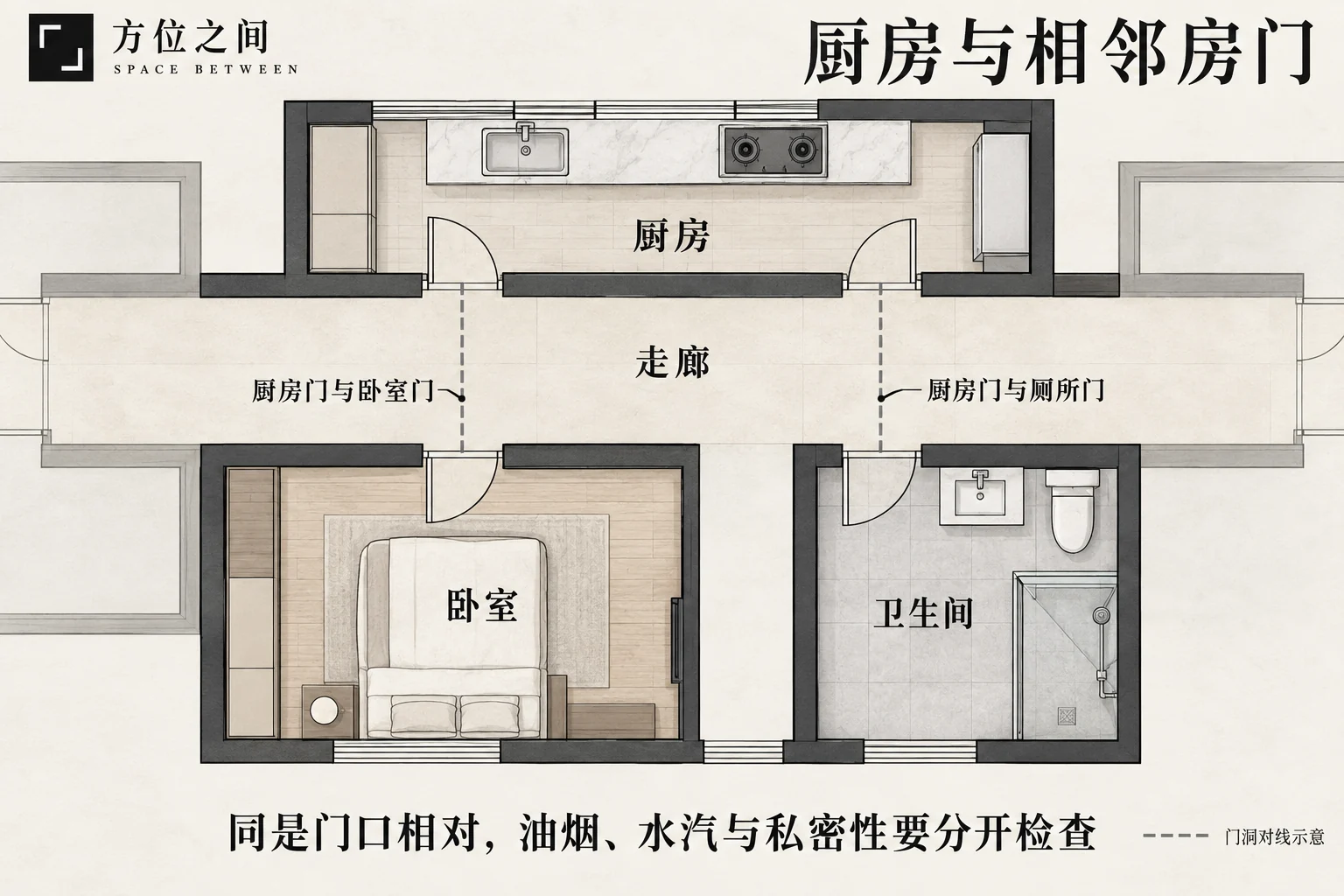
Kitchen doors facing bedroom or toilet doors are often grouped as door or water/fire clashes, but cooking emissions, bathroom moisture and bedroom privacy are different issues. A central kitchen instead concerns its location in the whole plan and extraction route, not just its doorway. Define the indoor boundary before locating the center, rather than manipulating a nine-palace overlay to obtain a conclusion.
How to identify it step by step
Start from the position people actually use, recording shape, spatial relationship and duration separately. These checks distinguish conditions; they are not a universal formula for fortune.
- Draw kitchen, bedroom and bathroom doors, distinguishing direct opposition, offset doors and passages with turns.
- Check for a suitable kitchen extraction route and note where odors actually travel during use.
- Record bathroom ventilation, drainage and the usual door position separately. Closing the door is not the entire solution.
- Specify whether the center is an area centroid, geometric center or a palace in a particular school; these need not be the same point.
How to understand the folk account
Offending the Kitchen God and fire affecting the central palace come from hearth-deity beliefs and center symbolism. They do not establish that a layout causes stroke, poisoning or shortened life. Folk preference for separating kitchen and toilet can illuminate household order; the kitchen still needs assessment through equipment and environmental conditions.
What matters in present-day living
Cooking emissions, bathroom moisture and household sound need separate responses. Slightly offsetting doors without improving extraction may not change experience. Conversely, independent effective facilities and reasonable habits may limit disturbance even when doors face each other.
Traditional responses and practical adjustments
Traditional ideas of avoiding, screening, buffering and separating can be understood as reorganizing sightlines, circulation and activity areas. Try small reversible changes first, then consider permanent alterations if they help.
- Check and maintain each room's extraction equipment first.
- Adjust door-opening habits to household use and avoid directing odors into resting areas.
- Use doors, turns in the layout or partial screening to protect privacy while preserving circulation.
- Assess construction conditions before altering shafts, gas or extraction. Do not relocate services solely according to folk directions.
Common misreadings and related names
Facing kitchen and toilet doors and a central toilet concern different spatial scales.
A bedroom larger than the living room concerns proportions and function, not the same relationship as facing kitchen and bedroom doors.
Sources and further reading
These sources help clarify the concepts and their origins. Explaining a traditional term does not establish that it can predict outcomes.