
Name and background
The White Tiger is also a guardian, not inherently bad. Raised head describes relative height; pressure describes proximity and visual occupation. An open-mouth variant may concern an opening or passage on the right. Merging them confuses a permanent block with temporary works, or an ordinary doorway with a high wall.
Typical form and comparisons
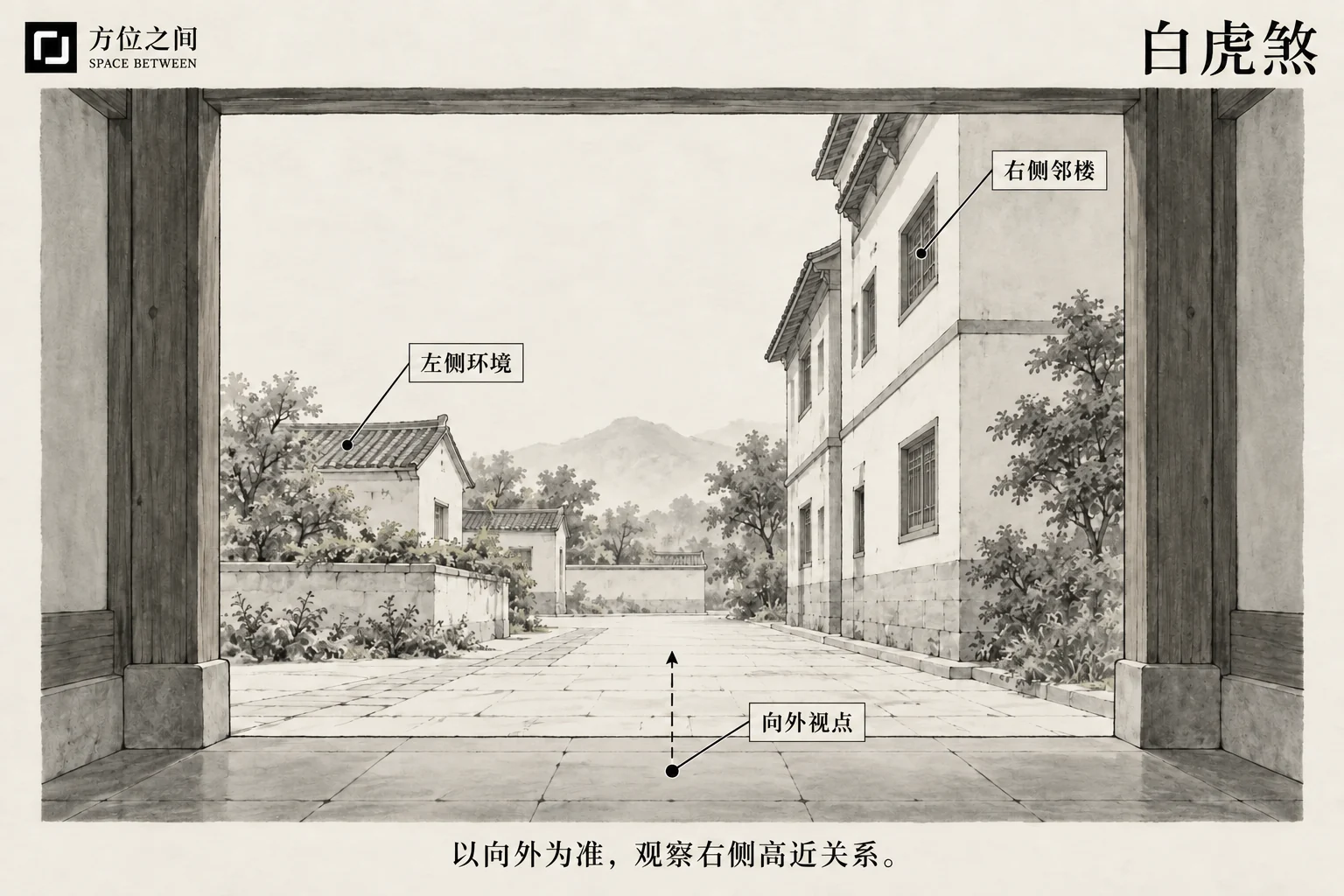
A tall right neighbour across a broad courtyard and at the edge of the view differs from a side wall close to a bedroom window that limits visible sky. Include a hill or closer block on the left. Equal storey counts can still yield different roof heights when ground levels differ.
If the dwelling and building entrances face differently, draw them separately instead of changing reference mid-assessment. A shop’s right side may be a loading area with timed activity; account for actual disturbance without treating a temporary construction period as permanent tiger movement.
Traditional reasoning and modern observations
Traditional Dragon and Tiger symbolism personifies forms on either side and uses their balance to discuss hierarchy. Some later accounts prefer a stronger Dragon side and worry about a dominant Tiger. Duoneng Bishi also calls a left-low, right-high arrangement favourable for a dwelling, showing that no single maxim represents all traditions.
Modern assessment asks which side actually shades, makes noise or obstructs use. Shading depends on orientation, distance and sun position; construction noise on processes and timing. The same taller-right relationship may involve a broad court or a narrow alley and cannot alone determine living quality.
How to identify it
Fix the left-right reference before considering height, proximity and activity.
- Mark the viewpoint, outward arrow and entrance, specifying dwelling or whole building; do not reverse sides according to the photograph viewer.
- Compare actual rooflines, nearest distances and visible sky on both sides, noting front and rear openness too.
- Separate building obstruction from works, air conditioners or loading, logging affected rooms and times.
Common points of confusion
The Tiger side here is relative, not invariably west or a calendar omen. Close blocks on both sides also call for the compressed-building entry; four-sided enclosure is closer to solitary yin. A door on the right alone is not the separate mouth-like opening facing an entrance.
Effects described in traditional beliefs
Ailan calls a taller Tiger side a raised Tiger head and gives it adverse meanings. The following summarises its folk claims; gender hierarchies are not used to judge families, and these claims do not establish engineering problems.
- Household fortunes: dominance on one side is read as declining fortune and an unsettled home, expressing a fear of imbalance.
- Accidental harm: the fierce animal image produces an injury association; falling-object, construction or access hazards require separate site evidence.
Traditional remedies and practical improvements
Improve usable relationships between the sides rather than competing with neighbours in height.
- Where a close wall crowds a side window, remove tall furniture, turn reading seats toward openness and add task lighting; lighting does not restore sunlight.
- For temporary works, give management specific noise records and discuss scheduling; move rest areas away from that side where feasible.
- Where loading occurs on a shop’s right, separate waiting customers from vehicle operations and keep the entrance visible and clear; address disturbance rather than which side wins.
- Some folk practice places dragon ornaments on the Dragon side, as the author describes. An existing small indoor ornament can serve symbolically; no prescribed number, material or new set is needed, and it does not replace lighting or construction measures.
Illustrative example
Suppose a south-facing home has an eight-storey block on its right and four storeys on its left, but the right block stands across a broad court. The real noise is renovation on the left. The resident records the taller right side yet addresses noise on the left and retains the courtyard light for reading. This hypothetical case shows that folk direction and actual problems need not coincide.
Sources and further reading
These sources help clarify the concepts and their origins. Explaining a traditional term does not establish that it can predict outcomes.