
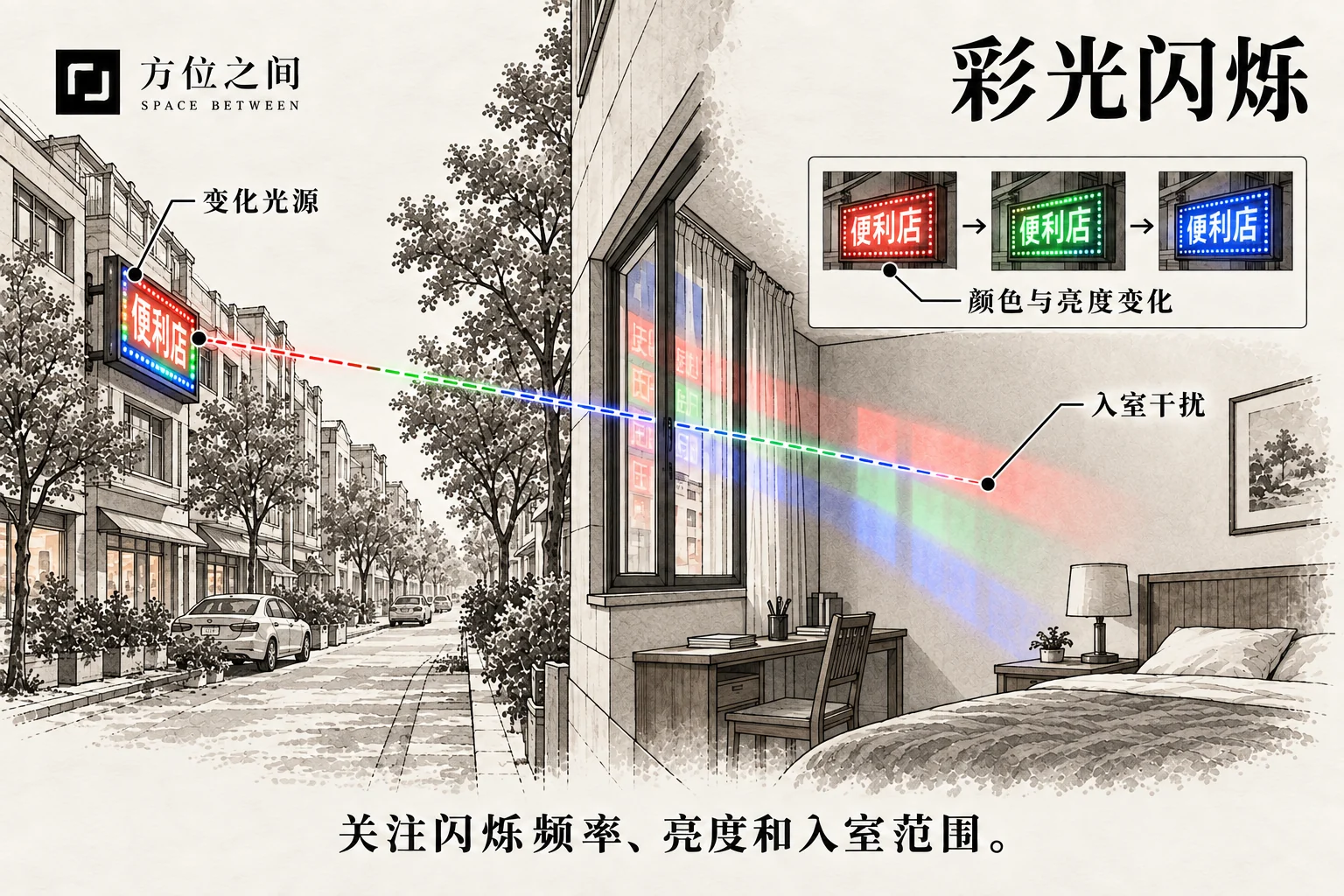
Defining features
Examples include rotating advertisements, chasing LED strips and unstable dimmed lights. Color change and light-output variation may occur together or separately. Assess distraction during reading or rest through brightness, rhythm and position.
How to recognize it
Compare fixed color, dynamic mode and off states, and check dimmer compatibility. Flicker appearing only when dimmed suggests checking the equipment. Video stripes depend on shutter settings and do not alone establish a flicker metric or health risk.
Common confusions
Steady red or blue decoration differs from rapid alternation; changing ad content differs from electrically driven periodic flicker. Invisible flicker is still possible, while visible video stripes are not proof of a disease cause.
Folklore and sources
“Colored-light sha” is a modern grouping without a verified dedicated classical source. DOE material distinguishes modulation from visual responses, not five-color antagonism. Folk associations with agitation cannot classify a resident’s personality.
Traditional responses and practical improvements
A preference for steadiness can mean stable colors and fewer animations. Disable unnecessary dynamic modes, check compatible drivers and dimmers, and adjust screens or curtains. Stop exposure and seek suitable help if discomfort persists; talismans do not repair faulty lighting.
Sources and further reading
These sources help clarify the concepts and their origins. Explaining a traditional term does not establish that it can predict outcomes.