
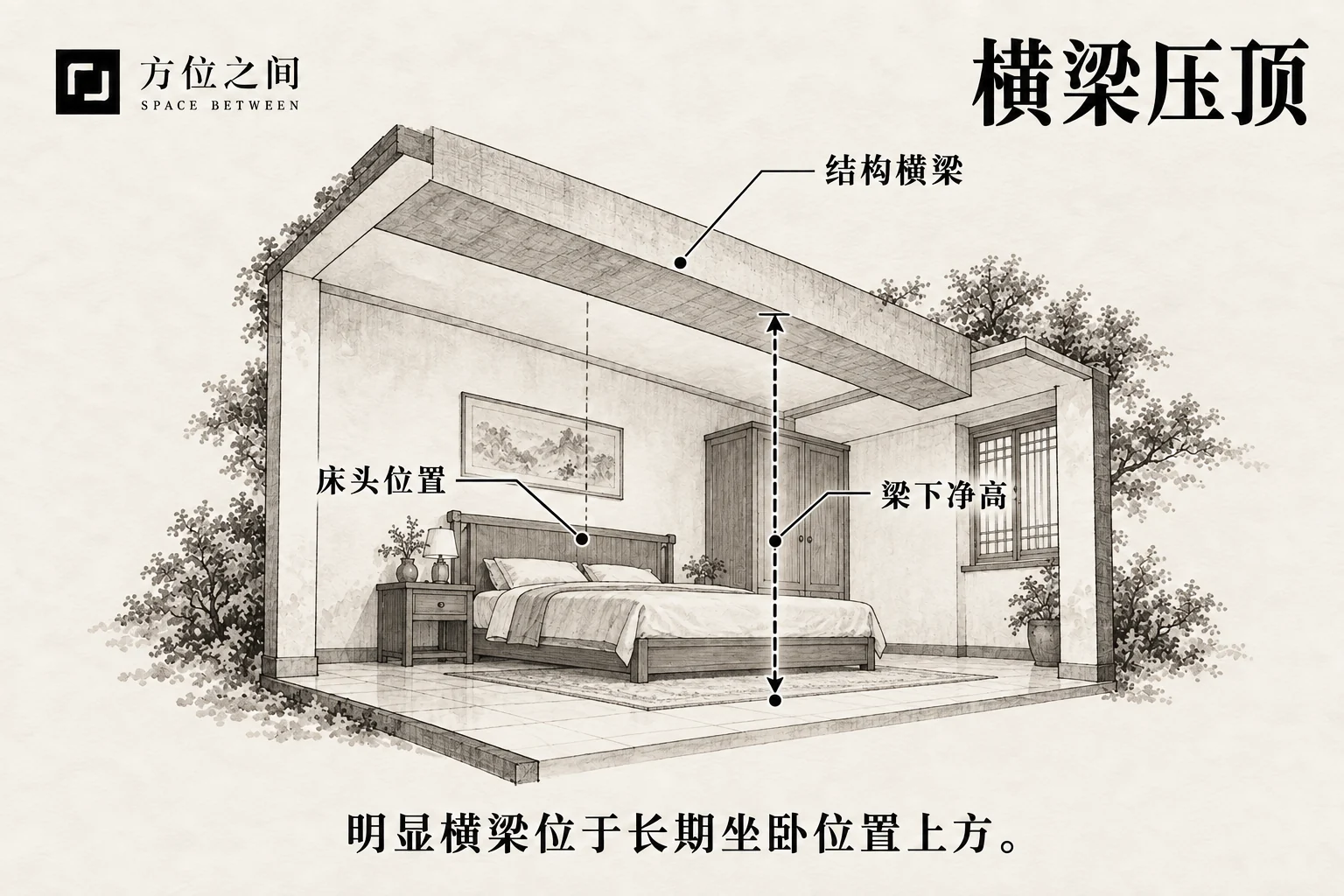
Name and background
The “overhead pressure” image concerns overlap between a person’s position and a projecting element, not only a beam directly over the head. Modern folklore also discusses beams running along a bed or across dining tables and workstations. Describe a boxed-in beam at the bedhead, a central crossbeam and an edge beam over a sofa separately before choosing a response.
Typical form and comparisons
Examine both the plan projection and vertical clearance. A beam crossing open space at the foot of a bed differs from a low beam directly over the pillow, and a broad shallow beam differs from a narrow deep one. Include nearby pendant lights or wall cabinets when assessing usable headroom instead of measuring only the original ceiling.
Traditional reasoning and modern observations
Tradition reads a visibly low beam as a burden overhead and considers this image unsuitable above places of sustained rest or work. Moving the bed or seat is therefore a common response. Some contemporary writers also use qilin figures or coin strings as protective symbols. Practices vary; they do not establish a measurable disease-causing force in a load-bearing element.
Modern checks concern headroom, movement space, lighting and the element’s condition. Someone who finds a low beam conspicuous or restrictive can compare positions after moving furniture. A feeling of pressure cannot diagnose structural problems. The Buildings Department identifies concrete spalling and abnormal cracking among defects requiring attention; visible signs call for investigation rather than concealment.
How to identify it
Locate the places used for long periods, then check the beam’s extent and height. When renting or renovating, use front and side photographs with a dimensioned plan; perspective can make a nearby beam appear directly overhead.
- Mark pillow position, seated head position and the place used to stand up. Check whether they fall beneath the beam, rather than treating any overlap with the bed frame as equivalent.
- Measure clearance below the beam and its depth. Try sitting, standing and reaching; assess passages, bedside standing areas and inaccessible storage zones separately.
- Check original drawings or ask a professional whether it is a structural beam, service enclosure or decorative feature. Note cracking, spalling and water marks; do not test by chipping or cutting it yourself.
Common points of confusion
An ordinary door-frame top or dark horizontal stripe is not an overhead beam merely because it forms a line. A projecting wall edge beside a bed is a different blade-edge relationship, while a bed beneath stairs involves slopes, steps and footfall. Boxing a beam into a ceiling changes its appearance, not its structural existence or maintenance needs.
Effects described in traditional beliefs
Signed articles by Bai Ruxue and Kwong Tsz-kit record contemporary beam-related beliefs, summarized below. These are folk attributions; beam position cannot diagnose illness, work performance or other people’s attitudes.
- Health and rest: a beam over the bed is associated with illness, unsettled sleep or nightmares, using overhead weight as an image of uneasy rest.
- Work and relationships: a beam over a workstation is said to signify constraint, criticism or difficulty gaining a supervisor’s approval. This extends the pressure metaphor to social life; it is not a rule of workplace evaluation.
Traditional remedies and practical improvements
Adjust the person’s position before deciding on renovation. A beam cannot be freely cut away to address a folk label, and ornaments or suspended ceilings do not provide structural strengthening or medical treatment.
- When furniture can move: move the pillow position, usual sofa seat or desk chair fully out from under the beam, then test sitting and standing. Moving only a decorative headboard while leaving the sleeper in place does not change the relationship.
- When a beam is close to a side wall: place low storage that does not require standing beneath it there, moving the bed or seat naturally away. Keep doors and storage easy to reach and avoid adding a heavy overhead cabinet.
- When appearance is the main concern: use a ceiling-like color and soft lighting to reduce harsh contrast. Test a small area first; improved appearance does not establish a cure for illness or interpersonal problems.
- Before boxing a beam or installing a flat suspended ceiling: check finished headroom, lighting and service access with suitable professionals. Investigate cracks, leaks or spalling before concealing anything.
- For traditional ornaments: coin strings and qilin figures serve as protective symbols for some writers. Choose small, securely placed items; do not suspend heavy objects over the bed, drill the beam for installation or buy something claimed to be the only effective remedy.
Illustrative example
Example: a bedroom edge beam lies over the pillow, with room to move at the foot of the bed. The occupants shift the whole bed outward, add a low cabinet between the wall and bedhead and test standing and reaching. The beam receives only a light finish, leaving it inspectable. This illustrates moving the sleeping position away from a beam; it assumes neither prior illness nor improved fortune afterward.
Sources and further reading
These sources help clarify the concepts and their origins. Explaining a traditional term does not establish that it can predict outcomes.