
Name and background
“Blade” emphasises a thin cutting-looking edge, while “corner” emphasises the meeting of two surfaces; both may occur together. This entry covers nearby interior edges, while a neighbouring building’s long wall edge is treated separately as wall-knife sha. Entry partitions are common examples, but their thickness is not a universal fortune threshold: ten centimetres in an illustration is not a rule for every home.
Typical form and comparisons
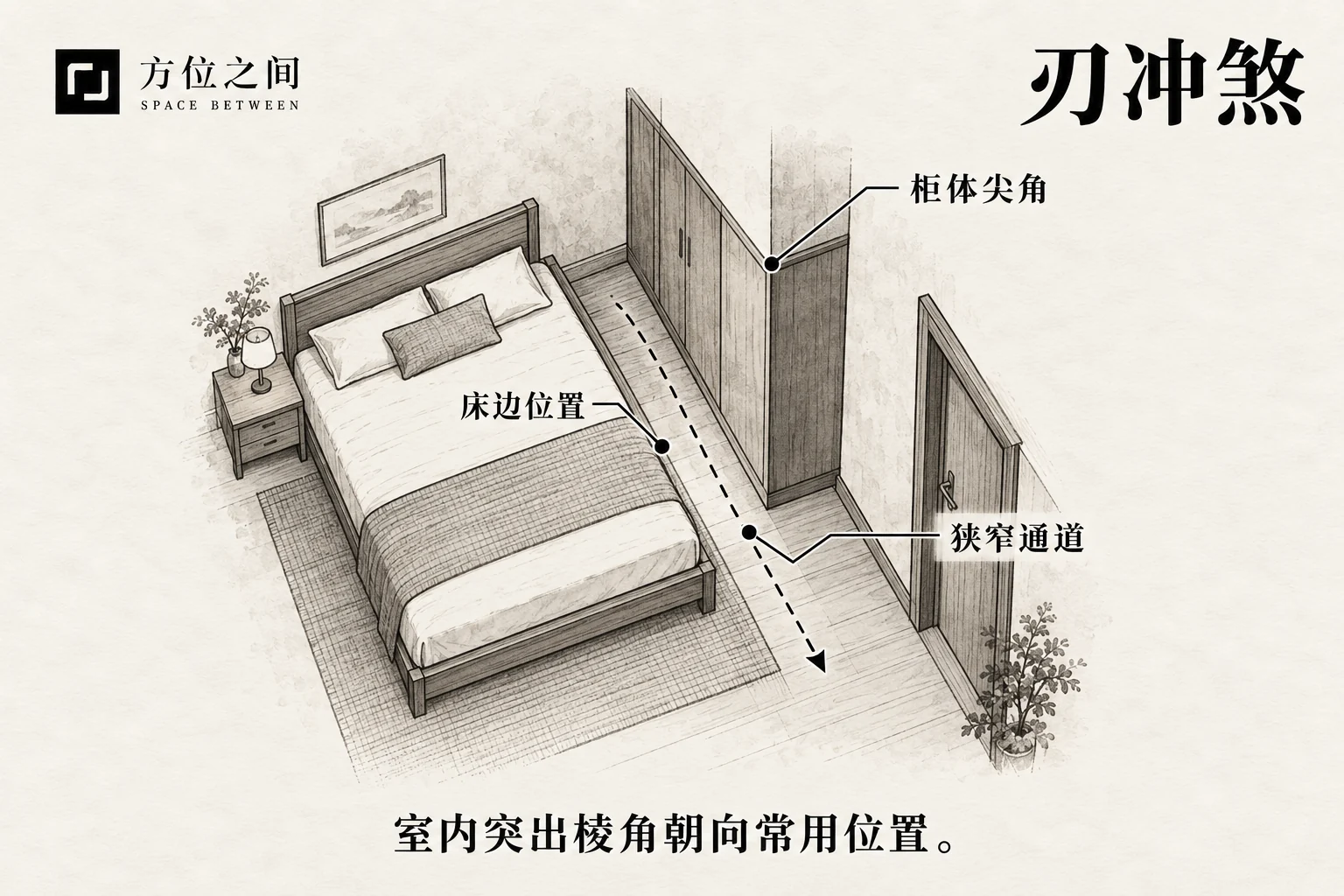
Typical cases include a thin entry partition facing a sofa or a tall cabinet projecting beyond a wall beside the head of a bed. A plan shows direction, while an elevation shows height relative to the head, shoulder or knee. A distant corner outside activity routes is mainly a visual matter; furniture narrowing a bedside route makes standing up and passing through the priority.
Traditional reasoning and modern observations
Traditional imagery treats the edge as a blade and the occupied position as its recipient, favouring softened, recessed or screened arrangements. “Clash” first describes alignment. A diagram’s extension line makes that relationship visible; it is not a measured ray or evidence that partitions emit an energy into the room.
Modern observation separates visual discomfort, contact opportunities and furniture stability. Rounded cabinets may still obstruct a passage, while sharp corners recessed within a boundary may not. The US Consumer Product Safety Commission lists corner and edge bumpers as one measure to reduce injuries from contact with sharp furniture edges. That addresses physical contact, not fortune; clearance and stability still need checking.
How to identify it
Observe normal use before linking the edge and person on a plan; do not move a chair simply to create an alignment.
- Identify the object: movable furniture, decorative panel or wall/column. Record projection, edge height and usable passage space; do not turn unknown dimensions into precise guesses.
- Try sitting, standing, opening the cabinet and carrying objects. Check where people and doors pass, and whether the corner is visible at night.
- Separate results: visual discomfort, snagged clothing and actual body contact are different observations. Keep a whole-room photograph rather than only a magnified corner.
Common points of confusion
Blade-edge sha concerns a nearby edge beside or ahead of a person; beam-overhead concerns a component above; exterior wall-knife concerns another building. Similar metaphors do not make their remedies interchangeable. Offset doorways are also sometimes described as wall-knife, but involve opening positions and use. A normal frame, a cabinet set against a wall or a decorative line is not automatically blade-edge sha.
Effects described in traditional beliefs
Designer Chen Junhong’s office wall-knife article associates partition edges and seating with two folk concerns. This is a modern usage related to blade-edge sha. The symbolism below is not a prediction of illness, accidents or workplace relationships.
- Disputes and friction: an edge appearing to cut into a seat is associated with misunderstanding; actual work disagreements still call for direct discussion.
- Concern about injury: the blade metaphor becomes an omen of bodily harm. This differs from actual corner contact; an injury should not automatically be attributed to a cabinet corner.
Traditional remedies and practical improvements
First create usable space, then improve the view. Traditional ideas of avoiding or softening an edge can become the following practical adjustments; added objects should not create crowding.
- When furniture enters a passage, move it back or elsewhere and test sitting and carrying routes. Do not clear the corner while leaving the open drawer in the same passage.
- For an immovable furniture edge that can actually be struck, fit suitable corner or edge protection as directed and check that it stays attached. This cushions contact; furniture stability remains a separate check.
- If the issue is visual alignment with adequate clearance, turn the chair or adjust the view and lighting. Small plants used to soften the view belong on stable surfaces, clear of bedside routes.
- For office partitions facing another seat, agree a desk or screen adjustment that leaves both users room. In shops, move waiting seats away from projecting cabinetry without obstructing service.
- Before changing a wall, column or fixed partition, check structure, services and fixings. Do not cut structural material to remove a supposed sha corner. Shanhaizhen or similar protective ornaments can remain cultural displays, not substitutes for clearance or contact protection.
Illustrative example
Illustrative example: a new tall cabinet faces a bedside chair, and its open drawers also occupy the nighttime walking route. The resident moves the cabinet to another wall, adjusts the chair, and fits suitable protection to a low table corner still within the activity area. People and drawers no longer share the same passage, and the chair no longer faces the cabinet edge. The same cabinet in another room may need no change if it already sits within a clear layout.
Sources and further reading
These sources help clarify the concepts and their origins. Explaining a traditional term does not establish that it can predict outcomes.