
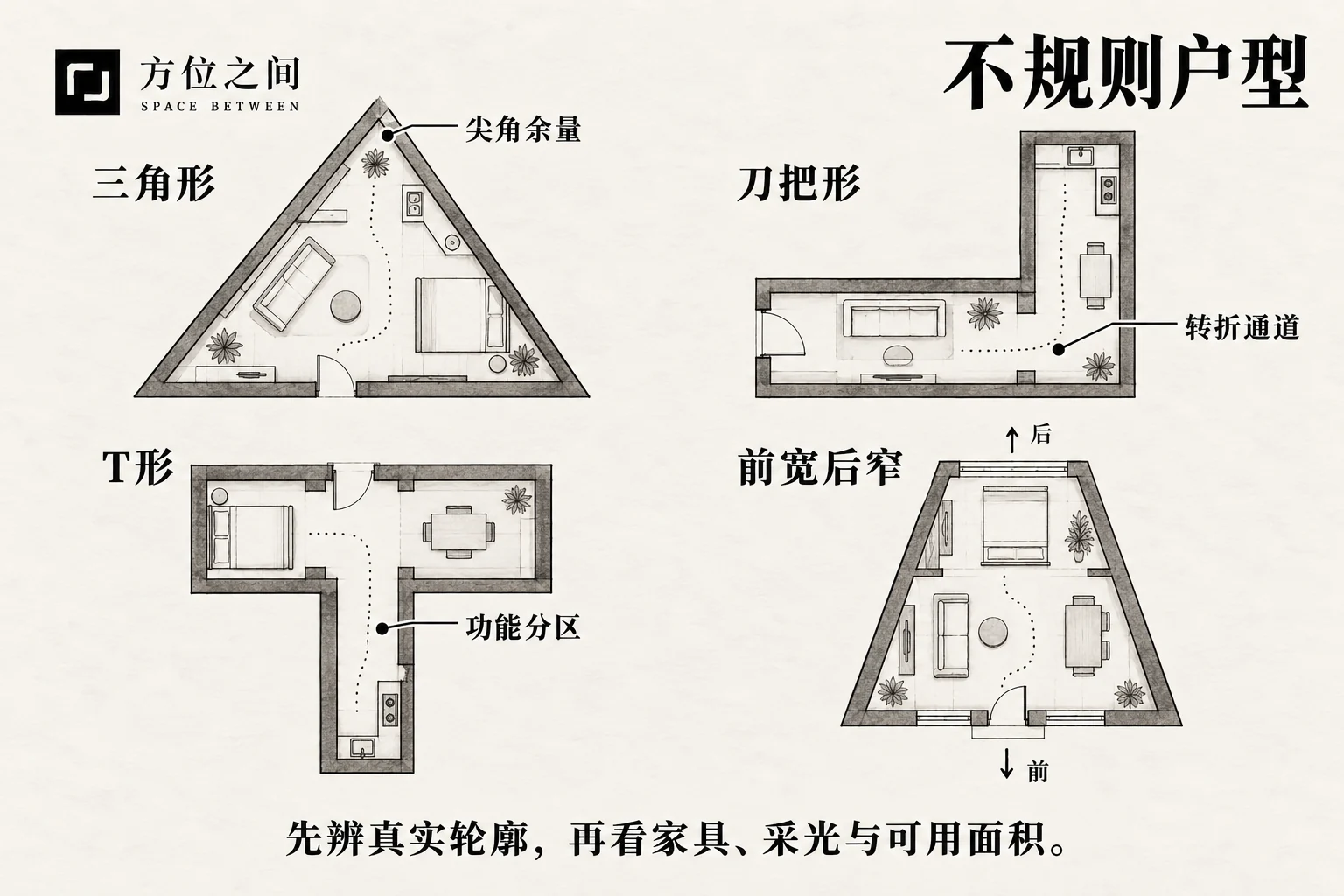
Name, characteristics and scope
An irregular room has angled, stepped, recessed or polygonal boundaries. Triangle, knife handle and T shape are different shape metaphors. The outline of the whole dwelling must be distinguished from one bedroom or kitchen. A T shape is not the same as a wide front narrowing toward the rear, often called dao'ao in traditional writing. Variant wording such as tui-tian-bi needs a version note.
How to identify it step by step
Start from the position people actually use, recording shape, spatial relationship and duration separately. These checks distinguish conditions; they are not a universal formula for fortune.
- Draw the actual usable indoor boundary without casually filling in shafts, balcony projections or communal space.
- Mark furniture, walkable areas and difficult sharp corners. Compare usable space rather than only total area.
- For bedrooms, check bed placement, windows and storage; for kitchens, check worktops, equipment and extraction. Their use criteria differ.
- Show whole-home and room boundaries together so a local recess is not mistaken for a missing corner of the entire dwelling.
How to understand the folk account
Traditional preference for regularity and balance links pointed, incomplete or elongated plans with instability or dispersed qi. Claims connecting irregular rooms with infertility, miscarriage or affairs lack reliable support and should not frighten occupants. Shape can affect furniture placement; it does not determine a family's character or fate.
What matters in present-day living
Furniture fit, usable area, daylight distribution, turns and cleaning are the practical issues. An angled room can have good views or a sound layout; a plan label alone cannot condemn it. Before moving kitchen equipment, verify installation and maintenance conditions instead of blocking windows or routes to make the room square.
Traditional responses and practical adjustments
Traditional ideas of avoiding, screening, buffering and separating can be understood as reorganizing sightlines, circulation and activity areas. Try small reversible changes first, then consider permanent alterations if they help.
- Use awkward corners for suitable storage while keeping main routes clear.
- Choose appropriately sized furniture and first simulate placement with floor markings.
- Use furniture or lighting to organize the view, without building into communal or structural areas.
- Check professional requirements before changing walls, drainage or gas. Do not sacrifice usability simply to obtain a square form.
Common misreadings and related names
A knife-handle label does not make every L-shaped dwelling uninhabitable. Compare proportions, openings and uses.
Some lists mix T shapes, ding-shaped houses and wide-front/narrow-rear plans. This entry explains their visible outlines separately.
Sources and further reading
These sources help clarify the concepts and their origins. Explaining a traditional term does not establish that it can predict outcomes.