
Questions and answers
Are online fortune telling and online feng shui the same?
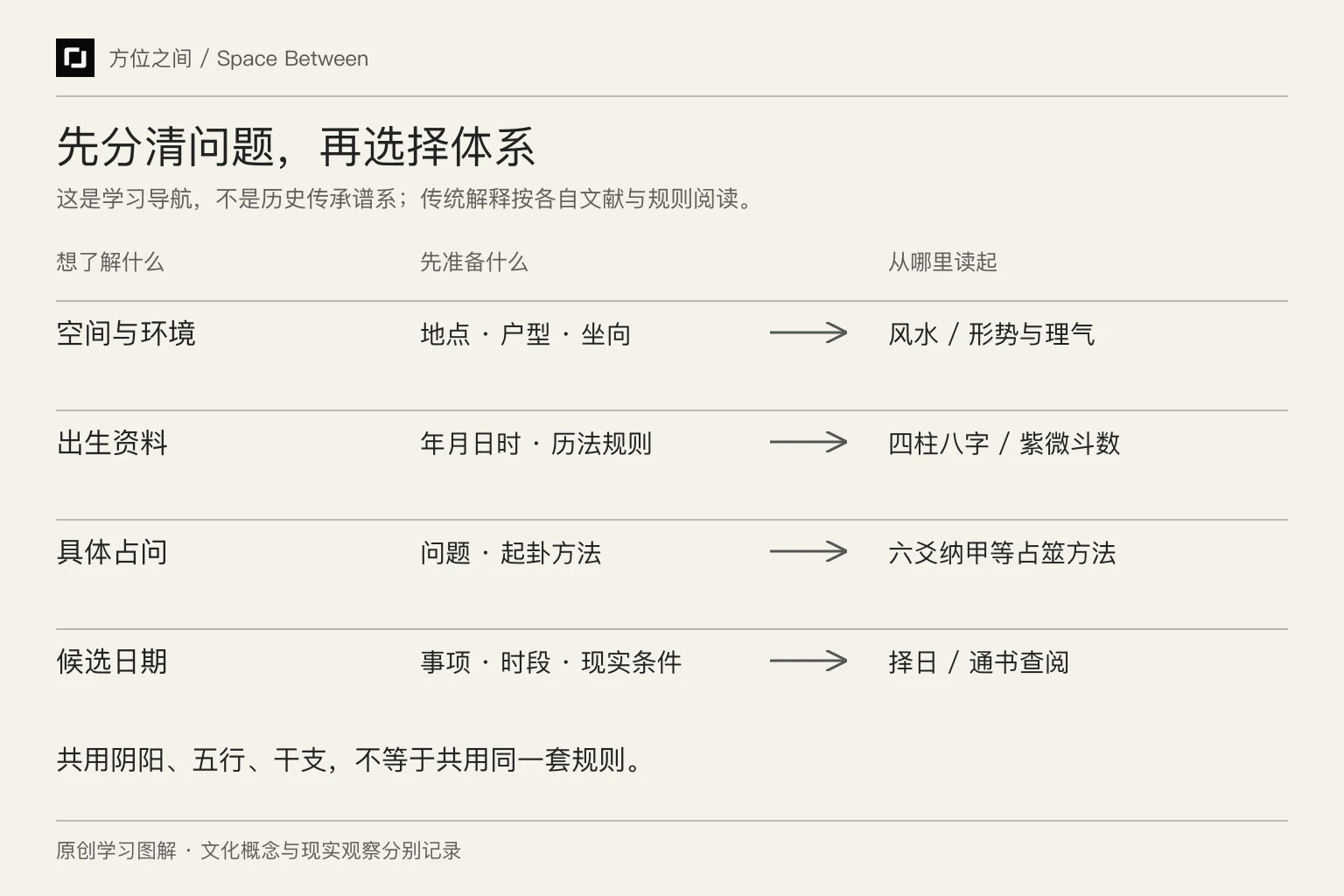
No. A reading may concern birth information or a particular divination question, while residential feng shui concerns a home’s boundary, orientation, openings and surroundings. Shared terms such as yin-yang and the Five Phases do not make their inputs interchangeable. A birth time cannot describe window obstructions, and a floor plan cannot supply a person’s Four Pillars.
Read the full explanationWhat information do BaZi, Zi Wei and Liu Yao use?
BaZi and Zi Wei Dou Shu usually construct charts from birth dates, times and their calendar rules. Liu Yao Na Jia concerns a specific question and records the casting method, original lines and relevant time. Their inputs and interpretation steps differ: shared terms such as the Five Phases or useful spirit are not interchangeable. The following details follow this site’s introductory articles.
Read the full explanationWhat should you prepare before an online consultation?
Write the question in one sentence, then confirm the method, required fields, charges and deliverable. Mark uncertain times as uncertain instead of inventing precision. For housing questions, prepare a plan, orientation source, photo times and living needs separately. Remove names, unit numbers and contact details from public posts and share only what the question requires.
Read the full explanationHow can you assess the accuracy of an online reading?
Separate reproducible chart calculation from a supported real-world prediction. Identical inputs producing the same chart establish consistency, not that an event will happen. Keep the original statement, when it was made, its conditions and the parts that did not match. Selecting only later coincidences is insufficient; an accuracy percentage needs a defined validation method and evidence.
Read the full explanationHow do AI-generated and human readings differ?
An AI answer, automatic chart calculation and a human interpretation are different steps. Ask which chart and inputs support a fluent answer and whether its rules can be reproduced. Human readings should also disclose their reasoning and assumptions. Neither an AI label nor an expert label establishes reliability. Space Between’s AI floor-plan recognition supports spatial records, not fortune telling or automatic destiny prediction.
Read the full explanationWhich related tools and reading does Space Between provide?
Calculation mode in the Space Between app includes personal-gua calculations, Xuan Kong flying-star charts and traditional calendar/date-selection tools. They use the dates, bearings and rules supplied. Check the inputs and method first: these tools do not scan a home and automatically score its fortune, or guarantee financial, health or other outcomes.
Read the full explanationAre online fortune telling and online feng shui the same?
No. A reading may concern birth information or a particular divination question, while residential feng shui concerns a home’s boundary, orientation, openings and surroundings. Shared terms such as yin-yang and the Five Phases do not make their inputs interchangeable. A birth time cannot describe window obstructions, and a floor plan cannot supply a person’s Four Pillars.
What information do BaZi, Zi Wei and Liu Yao use?
BaZi and Zi Wei Dou Shu usually construct charts from birth dates, times and their calendar rules. Liu Yao Na Jia concerns a specific question and records the casting method, original lines and relevant time. Their inputs and interpretation steps differ: shared terms such as the Five Phases or useful spirit are not interchangeable. The following details follow this site’s introductory articles.
- BaZi: birth date and time, calendar and time conventions; check pillar boundaries before interpreting the Day Master and Ten Gods.
- Zi Wei Dou Shu: palace and star placement under stated rules, separating the natal chart from time layers; the Property Palace is not a floor plan.
- Liu Yao Na Jia: a specific question, casting method, original lines and relevant time records; these steps differ from constructing Four Pillars from birth information.
What should you prepare before an online consultation?
Write the question in one sentence, then confirm the method, required fields, charges and deliverable. Mark uncertain times as uncertain instead of inventing precision. For housing questions, prepare a plan, orientation source, photo times and living needs separately. Remove names, unit numbers and contact details from public posts and share only what the question requires.
How can you assess the accuracy of an online reading?
Separate reproducible chart calculation from a supported real-world prediction. Identical inputs producing the same chart establish consistency, not that an event will happen. Keep the original statement, when it was made, its conditions and the parts that did not match. Selecting only later coincidences is insufficient; an accuracy percentage needs a defined validation method and evidence.
How do AI-generated and human readings differ?
An AI answer, automatic chart calculation and a human interpretation are different steps. Ask which chart and inputs support a fluent answer and whether its rules can be reproduced. Human readings should also disclose their reasoning and assumptions. Neither an AI label nor an expert label establishes reliability. Space Between’s AI floor-plan recognition supports spatial records, not fortune telling or automatic destiny prediction.
Example: what should you ask when comparing two homes?
Suppose Home A faces south but has a building outside its living-room window, while Home B faces east and has more complete opening records. “Which home will improve my luck?” mixes a personal reading with a housing comparison. First ask what evidence is missing about obstruction, ventilation and circulation under the same daily routine. Record any traditional interpretation and its conditions separately. This is a hypothetical exercise, not a client case or purchase conclusion.
Which related tools and reading does Space Between provide?
Calculation mode in the Space Between app includes personal-gua calculations, Xuan Kong flying-star charts and traditional calendar/date-selection tools. They use the dates, bearings and rules supplied. Check the inputs and method first: these tools do not scan a home and automatically score its fortune, or guarantee financial, health or other outcomes.
This article is a learning resource, not a personal fortune report or an ordering page for readings. For a housing discussion, use the app to organize a plan, directions and photos, then check the professional’s introduction and invitation scope. BaZi or Zi Wei articles on the site do not imply that every provider offers those consultations.
Sources and further reading
These sources help clarify the concepts and their origins. Explaining a traditional term does not establish that it can predict outcomes.