
Questions and answers
How do feng shui predictions differ from observing a home?
Home observation records boundaries, roads, openings, obstructions and use conditions. A traditional prediction adds an interpretation under chosen rules. “There is a building in front of the window” is a checkable spatial description; “the resident will therefore suffer misfortune” is an additional inference. Keep them separate and identify what comes from plans and what needs a site visit.
Read the full explanationIs a floor plan enough for an online feng shui discussion?
Usually not. A plan can show room and opening relationships but may omit north, scale, alterations and the view outside. Identify the dwelling boundary, direction source, openings and living needs; add daylight, noise, ventilation and on-site dimensions as the question requires. Missing information should become a checklist, not an assumed normal or abnormal condition.
Read the full explanationDoes an accurate orientation make a prediction accurate?
Reliable orientation records reduce direction-input errors. Specify whether you measured the building, entrance or window plane, the north reference and repeated readings. Clear inputs help reproduce a rule-based calculation but do not validate a forecast of future events. Fine numerical resolution on a phone compass does not establish equally precise conclusions about a home.
Read the full explanationHow can you tell whether an analysis answers your question?
Read the answer in four parts: observations, rules used, proposed action and missing evidence. A desk-move suggestion should locate the desk, identify the sightline or circulation issue and check door and cupboard clearance afterward. Labels such as attracting wealth or neutralizing sha cannot replace a specific layout recommendation. Record cultural preferences separately from observable improvements.
Read the full explanationCan feng shui predictions guarantee wealth or health outcomes?
Traditional fortune interpretations cannot serve as such guarantees. A layout change can be checked against a stated problem with circulation, obstruction or usability; that is different from demonstrating a change in someone’s destiny. Preserve uncertainty and do not substitute cultural interpretation for an engineering inspection or another assessment requiring specialized evidence.
Read the full explanationHow do feng shui predictions differ from observing a home?
Home observation records boundaries, roads, openings, obstructions and use conditions. A traditional prediction adds an interpretation under chosen rules. “There is a building in front of the window” is a checkable spatial description; “the resident will therefore suffer misfortune” is an additional inference. Keep them separate and identify what comes from plans and what needs a site visit.
Why can form, directional methods and the Three Essentials differ?
Form approaches emphasize the shapes and relationships of roads, buildings and spaces. Directional methods may add orientation, time and trigram or star rules. The Three Essentials focus on entrance, main living space and stove. Similar fortune labels from different conventions are not directly comparable. Keep the same dwelling boundary and direction records, identify each method and avoid combining unrelated rules into a single score.
Is a floor plan enough for an online feng shui discussion?
Usually not. A plan can show room and opening relationships but may omit north, scale, alterations and the view outside. Identify the dwelling boundary, direction source, openings and living needs; add daylight, noise, ventilation and on-site dimensions as the question requires. Missing information should become a checklist, not an assumed normal or abnormal condition.
Does an accurate orientation make a prediction accurate?
Reliable orientation records reduce direction-input errors. Specify whether you measured the building, entrance or window plane, the north reference and repeated readings. Clear inputs help reproduce a rule-based calculation but do not validate a forecast of future events. Fine numerical resolution on a phone compass does not establish equally precise conclusions about a home.
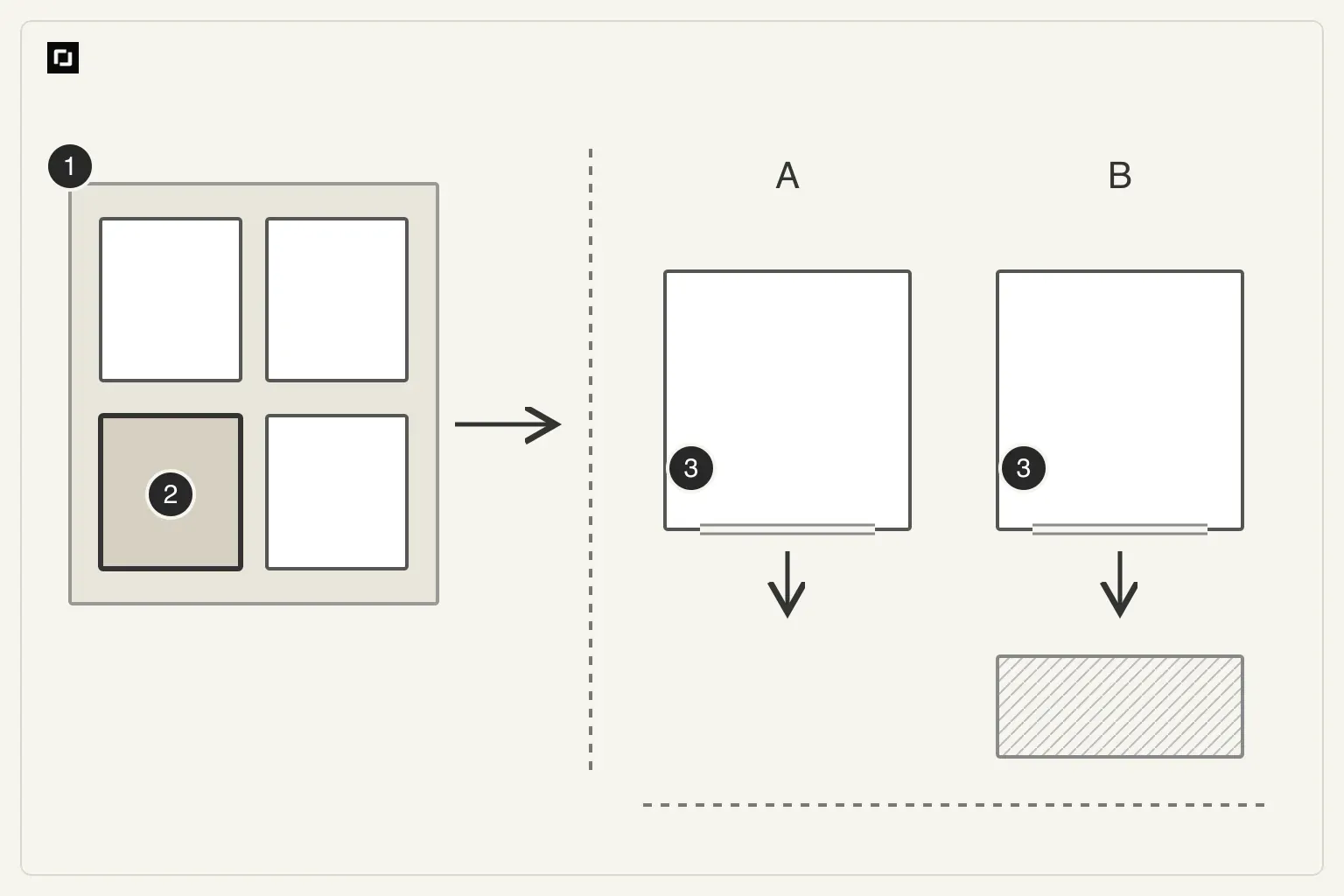
Apartment example: the same orientation can have different conditions
In the diagram, 1 marks the site, 2 the selected building and 3 the dwelling-level view. A and B are hypothetical homes facing the same way, with an obstruction outside B. Similar direction records do not establish equal daylight. Compare obstructions, window sizes and indoor experience under similar weather and use times before discussing furniture changes. Neither home receives a fortune label.
How can you tell whether an analysis answers your question?
Read the answer in four parts: observations, rules used, proposed action and missing evidence. A desk-move suggestion should locate the desk, identify the sightline or circulation issue and check door and cupboard clearance afterward. Labels such as attracting wealth or neutralizing sha cannot replace a specific layout recommendation. Record cultural preferences separately from observable improvements.
Can feng shui predictions guarantee wealth or health outcomes?
Traditional fortune interpretations cannot serve as such guarantees. A layout change can be checked against a stated problem with circulation, obstruction or usability; that is different from demonstrating a change in someone’s destiny. Preserve uncertainty and do not substitute cultural interpretation for an engineering inspection or another assessment requiring specialized evidence.
Sources and further reading
These sources help clarify the concepts and their origins. Explaining a traditional term does not establish that it can predict outcomes.