
Read each entry
Open a name for its meaning, identification, diagram and practical responses. Different meanings of the same name are distinguished.
State which meaning of qi is intended
In cultural explanation, qi relates to yin-yang, the five phases and transformation. In directional systems, terms can label time and location rules. Everyday speech also uses qi for air, atmosphere and sensation. Specific physical conditions require appropriate measurement; “energy field” is not a substitute for all these objects.
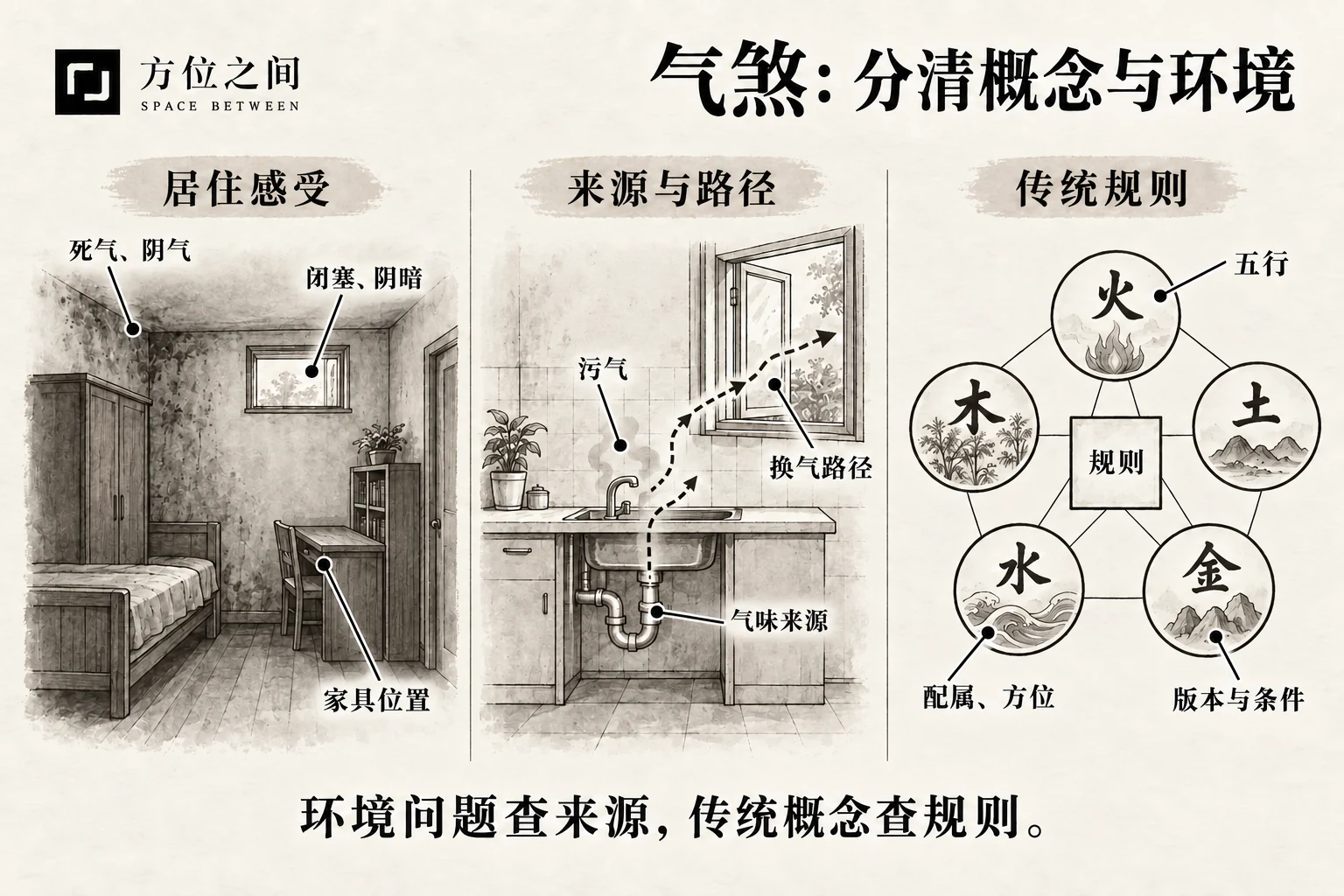
Stagnant qi: stuffiness is not declining fortune
Modern home commentary may call a closed, unused or stuffy room stagnant qi. Some directional texts use death or decline for phases of a cycle. One describes experience or use, the other a symbolic rule; a declining star does not establish stagnant indoor air.
Record closure periods, exhaust operation, blocked paths and when discomfort occurs. Revisit the experience after adjusting use or ventilation, while assessing pollution by its actual source rather than whether a room is occupied.
Yin qi: separate dimness, quietness and yin-yang
Yin is not inherently harmful in yin-yang thought. In everyday home discussion, yin qi may summarize dimness, dampness, quietness or feelings about a neighboring place. These can be independent; the name of a hospital, cemetery or temple does not establish an air-quality problem.
Check daylight, night lighting, visible moisture and persistent odor separately. Preferences for quiet or dim spaces vary with people and activities. Address actual conditions and discomfort rather than stigmatizing every quiet room or shaded facade.
Polluted qi: find sources; odor is not concentration
Polluted qi overlaps with odor and impurity terminology, covering drain smells, smoke, waste and renovation. Smell provides a clue, not a complete identification of substances; no odor does not establish that every air-quality measure is normal.
Improvement generally starts with source control, then suitable ventilation, exhaust and filtration in light of outdoor conditions. Opening windows continuously is not automatic advice when smoke is outside. Fragrance may mask odors without removing pollution; ornaments and plants do not replace source control.
Five-phase sha: state assignments, objects and rules
Five-phase sha is not one universal term. It may refer to color or shape correspondences, personal gua and direction, or other calendrical rules. Ask which phase system, which objects and which edition are involved; without inputs, a reading cannot be checked.
Assigning pointed forms to fire and curved forms to water is symbolic language; a pointed chair does not thereby emit a fire substance. Choose colors, furniture and materials by lighting, touch, dimensions and use. Traditional preferences may remain without replacing actual checks.
Turn a vague qi remedy into a checkable record
Record the room, time, circumstances of odor or stuffiness, equipment status and changes made. Keep directional rules, dates and chosen conventions on a separate page. Separate records preserve cultural context and let practical changes be evaluated.
Sources and further reading
These sources help clarify the concepts and their origins. Explaining a traditional term does not establish that it can predict outcomes.