
Name and meaning
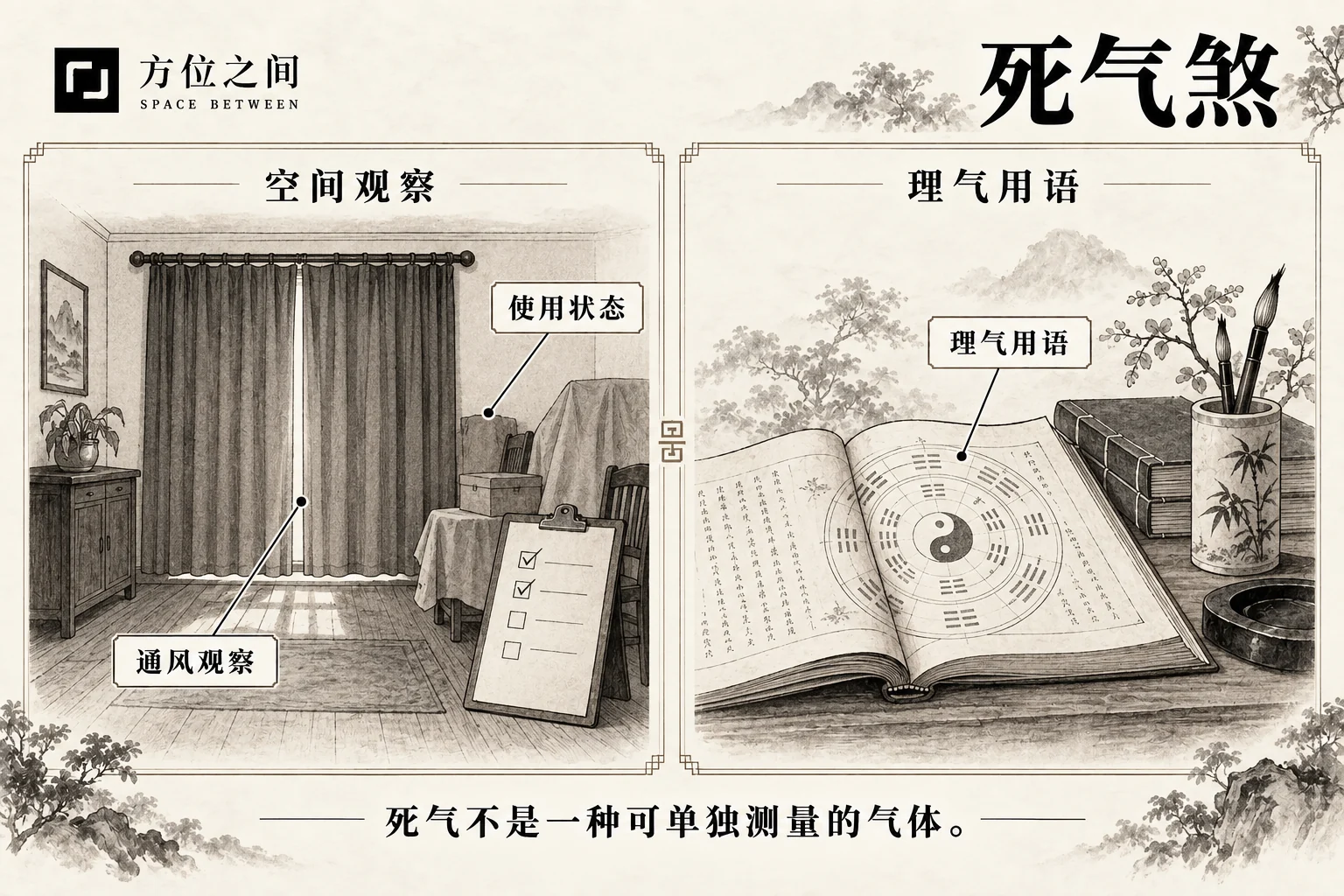
Dead-Qi Sha may describe inactivity, prolonged closure or a dull atmosphere, or appear in a traditional system’s assessment of a time cycle or star qi. These are different uses: one describes feelings and surroundings, the other requires specific rules. Dead qi is not a defined substance that can be measured as a separate gas.
Sources and spelling variants
Modern feng-shui writing may list dead qi alongside yin or polluted qi without a physical criterion shared across traditions. Ask whether the author discusses use, air exchange or chart phases. Without a stated system and subject, metaphors cannot become air-quality standards or justify identical conclusions about every vacant room.
Recognizing the context
For a supposedly stuffy room, record occupancy, windows, ventilation equipment, odors and moisture signs. Still-looking air does not prove excessive pollution, and feeling a breeze does not guarantee suitable air. A specific pollutant needs an appropriate investigation or measurement, not a generic dead-qi reading.
Folk interpretations and versions
Traditional contrasts such as living/dead and flourishing/declining describe change and vitality. They do not establish that a vacant home harms fortune or that moving water or a lamp changes destiny. A label produced by a traditional chart is not a measured ventilation rate, illumination level or pollutant concentration.
Practical observation and limits
Separate usability from environmental problems: blocked furniture routes, neglected maintenance and ventilation practices can all be described concretely. Environmental guidance supports pollution-source control and appropriate ventilation. These address physical conditions rather than validate a Dead-Qi Sha theory.
Reading and responding
Restore maintenance, define the room’s purpose and normal use, then address identified ventilation or source issues. Consider outdoor conditions before opening windows and do not conceal odors with fragrance. If discussing traditional qi calculations, list their rules and inputs separately; avoid blind renovation or purchases prompted by a vague label.
Sources and further reading
These sources help clarify the concepts and their origins. Explaining a traditional term does not establish that it can predict outcomes.