
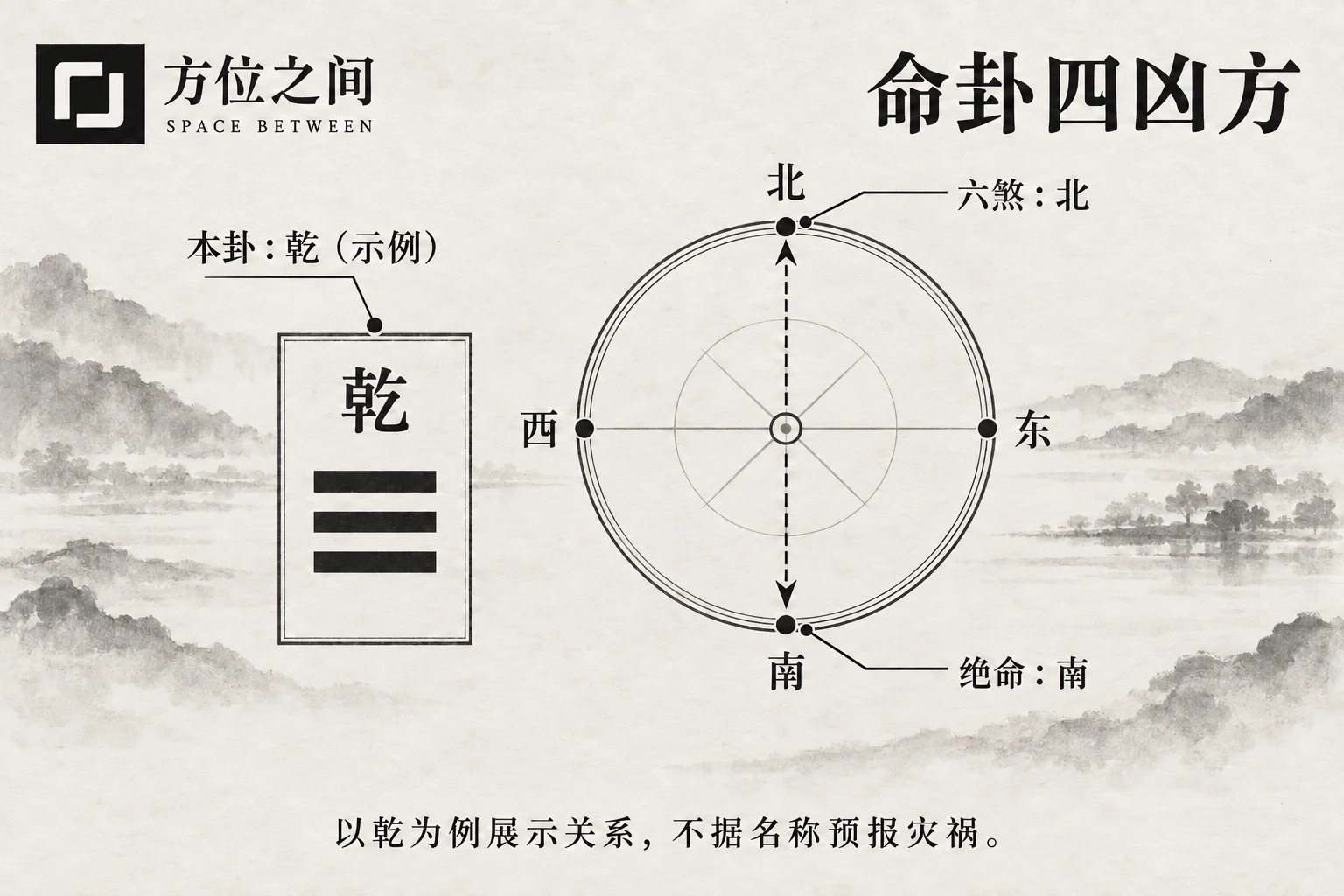
Name, characteristics and scope
Indoor liqi places furniture, openings or rooms within a directional system before interpreting them. A stove sitting south and facing north is an orientation; Liu Sha belongs to Eight Mansions terminology; Tai Sui and Three Sha involve time; Black Two illness symbolism is another naming layer. A single fixed fortune chart for every word containing sha loses these distinct premises.
How to identify it step by step
Start from the position people actually use, recording shape, spatial relationship and duration separately. These checks distinguish conditions; they are not a universal formula for fortune.
- State whether the rule comes from Eight Mansions, Flying Stars, annual deities or another system. Verify the source before calculating.
- Record sitting/facing, room center, dwelling center and the person's orientation separately. Do not interchange stove-mouth and working directions at will.
- Years, months, days and hours have distinct boundaries. Annual and monthly breakers are not the same hourly label.
- Check whether the written Bing Fu is a mistaken form of illness symbol. A divinatory illness symbol is not automatically the Black Two star either.
Time-period and directional clashes: one word, different rules
Time-period clash sha is an auspicious-timing concept using day/hour stems and branches and clash relationships; the source version must identify the two items being compared. Zi–Wu clash, for example, is a branch relationship, not a judgment made from one whole hour on a clock. Record location, time zone, date, day boundary and the definition of time periods. Annual and monthly breakers belong to year and month layers, not alternative names for one hourly taboo, and cannot predict an inevitable accident in a particular hour.
Directional clash sha may mean opposing palaces, annual-deity directions or personal gua relationships; popular writing may also use it for physical alignment of doors, windows or roads. The former needs a stated chart system, time and north reference; the latter needs observed axes, distance and screening. Both may appear in one source, but sharing the word clash does not make either prove the other. Direction labels cannot replace checks of equipment, circulation or structure.
- For time periods, list date, location, time zone, day boundary, period divisions and the stems/branches being compared. If a source says only that an hour is unfavorable without giving its rule, leave it unverified instead of inventing a definite result.
- For direction, draw compass directions and actual opening axes separately in the same record, stating whether the rule concerns opposing palaces, the current year or personal gua. Physical door alignment still needs a check of door positions and use.
How to understand the folk account
Liu Sha is associated with relationships and peach blossom, while Wu Gui, Jue Ming and Huo Hai carry traditional unfavorable symbolism. Living there does not therefore entail affairs, ghosts or a short life. Southern fire and northern water are one directional Five Phase correspondence, insufficient alone to set the installation direction of a modern stove.
What matters in present-day living
A direction chart cannot replace daylight, extraction, circulation or equipment checks. Blocking windows or doors, or placing a stove badly to avoid a palace, may worsen actual conditions. Even for cultural study, preserve inputs and versions so others can verify which layer of rules is being read.
Traditional responses and practical adjustments
Traditional ideas of avoiding, screening, buffering and separating can be understood as reorganizing sightlines, circulation and activity areas. Try small reversible changes first, then consider permanent alterations if they help.
- Use the chart as an explanatory diagram, shown separately from observations of the actual floor plan.
- When adjustments are wanted, prioritize small furniture changes that do not interfere with facilities.
- Discuss specific inconveniences with the household rather than judging partners or children through chart labels.
- Building and equipment conditions should govern major alterations. Traditional objects cannot guarantee risk removal.
Common misreadings and related names
Opposing palaces describe a relationship around a directional circle; facing doors describe spatial layout. Similar names do not make the reasoning identical.
Sanhe, Three Sha and Sanhe form sha require checking the particular version. Continue with the site's Tai Sui, Three Sha and Eight Mansions foundation articles.
Sources and further reading
These sources help clarify the concepts and their origins. Explaining a traditional term does not establish that it can predict outcomes.