
Name, characteristics and scope
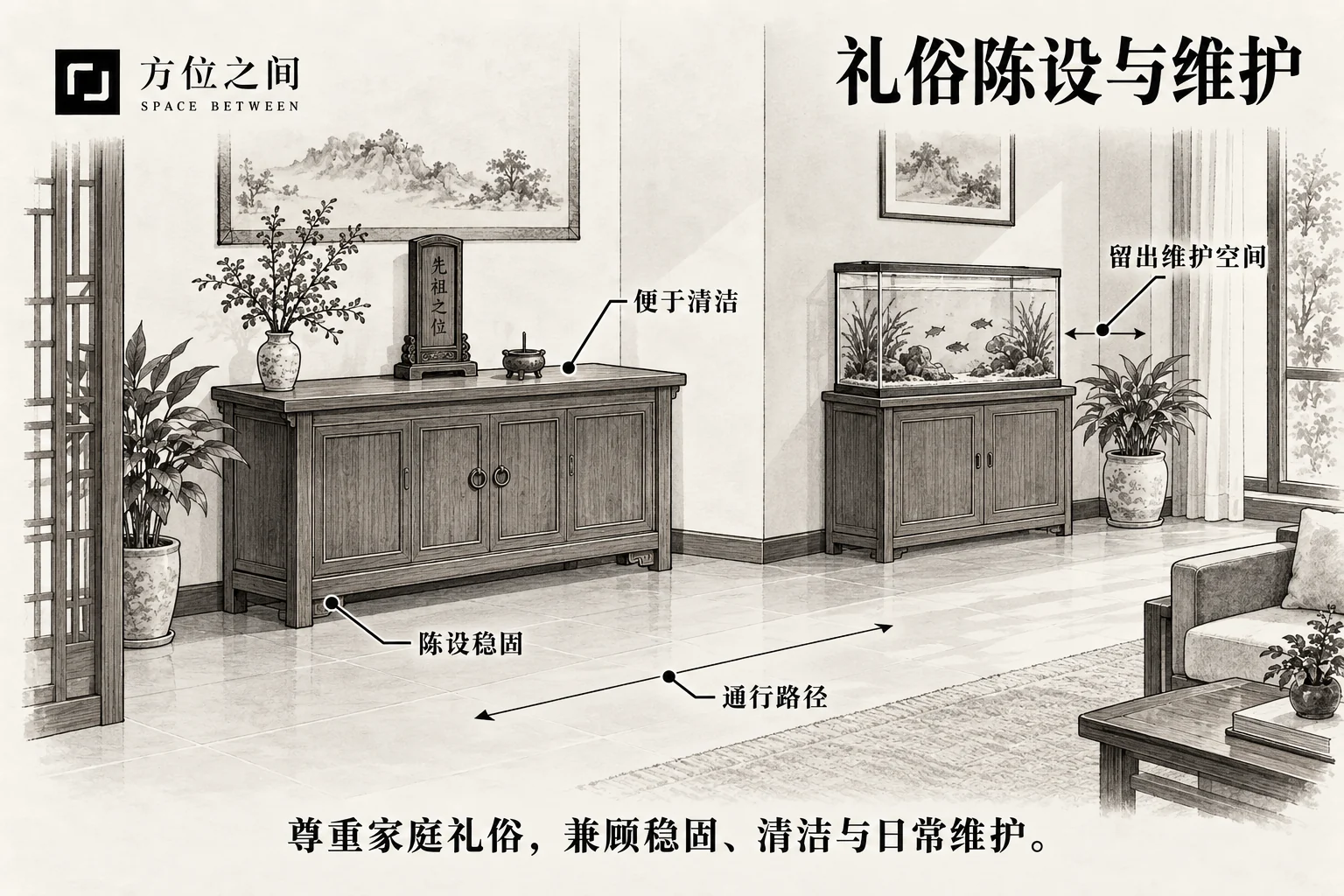
Placement of shrines and ancestral tablets first concerns family beliefs, ritual habits and agreement among household members. Facing a door, toilet or bed or lacking backing are not uniform taboos across places; an opposing aquarium adds water symbolism. Before explaining, clarify the object of worship, tradition followed and whether open flame is used. A generic direction chart should not define disrespect on a family's behalf.
How to identify it step by step
Start from the position people actually use, recording shape, spatial relationship and duration separately. These checks distinguish conditions; they are not a universal formula for fortune.
- Ask about household customs and feelings first. Distinguish shrines, ancestral tablets and ordinary memorial objects.
- Observe effects on opening doors, resting, cleaning and circulation, recording actual relative positions.
- Check stable altar tables, cabinets and heavy items, and whether aquarium support, water access and wiring permit maintenance.
- Where incense or candles are used, check fire precautions and ventilation separately. Religious meaning is not equipment guidance.
How to understand the folk account
Backing, avoiding impurity and preserving order often express respect and stability, but do not verify predictions that water facing a shrine will ruin a household. Ritual sequences vary locally; another family's practice should not automatically be called disorderly or used to judge its relationships.
What matters in present-day living
Respect, stability, cleanability, circulation and flame management are practical priorities. Whether an aquarium facing a bed disturbs someone depends on water sound, lighting, upkeep and room conditions, not an automatic disease prediction. Large or elevated objects also require stable placement.
Traditional responses and practical adjustments
Traditional ideas of avoiding, screening, buffering and separating can be understood as reorganizing sightlines, circulation and activity areas. Try small reversible changes first, then consider permanent alterations if they help.
- Agree within the household on a quiet, tidy and maintainable location.
- Keep altar tables, cabinets and aquariums stable, and place heavy objects away from collision and fall hazards.
- Follow practical fire precautions when using incense or candles, keeping combustible materials clear and providing supervision.
- If ritual adjustments are wanted, consult a traditional practitioner you trust. Frightening promises do not make particular purchased objects necessary.
Common misreadings and related names
This entry introduces ritual contexts without ranking religions or household customs.
The aquarium-stove relationship is covered in the water/fire entry. Object symbolism does not imply a universal ban.
Sources and further reading
These sources help clarify the concepts and their origins. Explaining a traditional term does not establish that it can predict outcomes.