
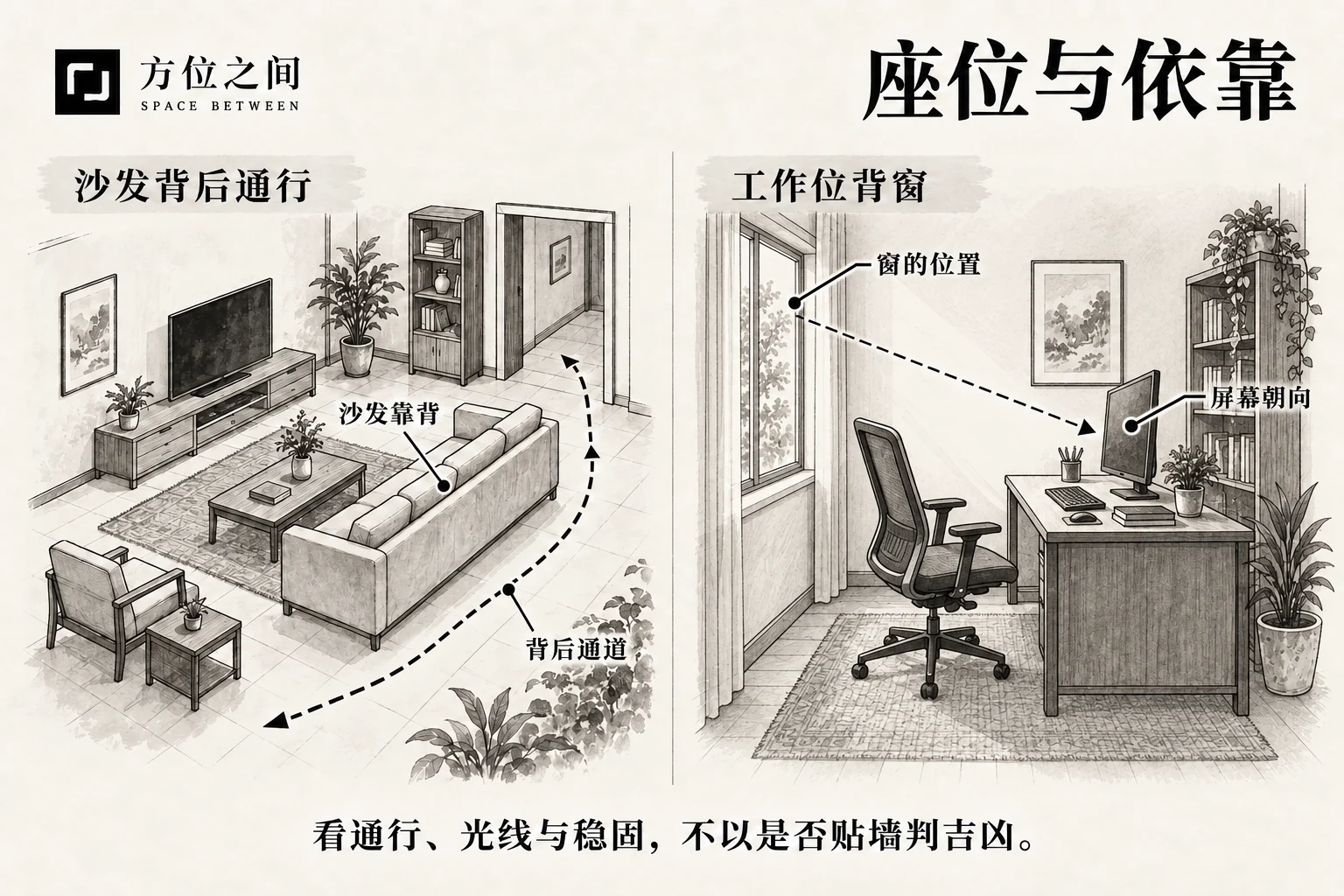
Name, characteristics and scope
A sofa without backing has no solid wall behind it; a seat with a window or door behind describes the seated person's relationship to that opening; a bedroom larger than the living room compares room area or scale. All may be used to discuss support and spatial hierarchy, but they measure different objects. Lacking backing does not mean furniture must always touch a wall.
How to identify it step by step
Start from the position people actually use, recording shape, spatial relationship and duration separately. These checks distinguish conditions; they are not a universal formula for fortune.
- Sit in the usual position and observe circulation, door movements, light and screen reflections behind you.
- Check the stability of the sofa or chair itself and any trailing cables behind it.
- Compare bedroom and living-room areas on the same basis, recording household size and habits.
- Establish whether the living room is regularly used for visitors or work or used infrequently. Area alone is not an evaluation.
How to understand the folk account
The backing-mountain image often symbolizes career support, while a larger bedroom may be described as reversed hierarchy. Claims of selfishness, withdrawal or unsupported careers are not established by this. Households with different lifestyles can reasonably choose a larger bedroom or study rather than conform to traditional communal-room proportions.
What matters in present-day living
Experience depends on frequent movement behind the seat, glare during work and ease of conversation and circulation. A centrally placed sofa can sensibly divide an open living room. A stable low cabinet behind it need not be condemned as lacking a backing mountain.
Traditional responses and practical adjustments
Traditional ideas of avoiding, screening, buffering and separating can be understood as reorganizing sightlines, circulation and activity areas. Try small reversible changes first, then consider permanent alterations if they help.
- Adjust seating angles to reduce disturbance from frequent movement behind people.
- Plan work positions using daylight and screen direction rather than seeking only a solid wall behind.
- Allocate rooms according to household activities, putting area into functions that are actually needed.
- When adding screens or tall cabinets, consider fixing, daylight and routes. Do not pile heavy objects behind a seat merely to create backing.
Common misreadings and related names
A window behind and a strong light source in front can cause different reflections. Observe from the actual position.
Room proportions do not define family status and cannot justify personality judgments.
Sources and further reading
These sources help clarify the concepts and their origins. Explaining a traditional term does not establish that it can predict outcomes.