
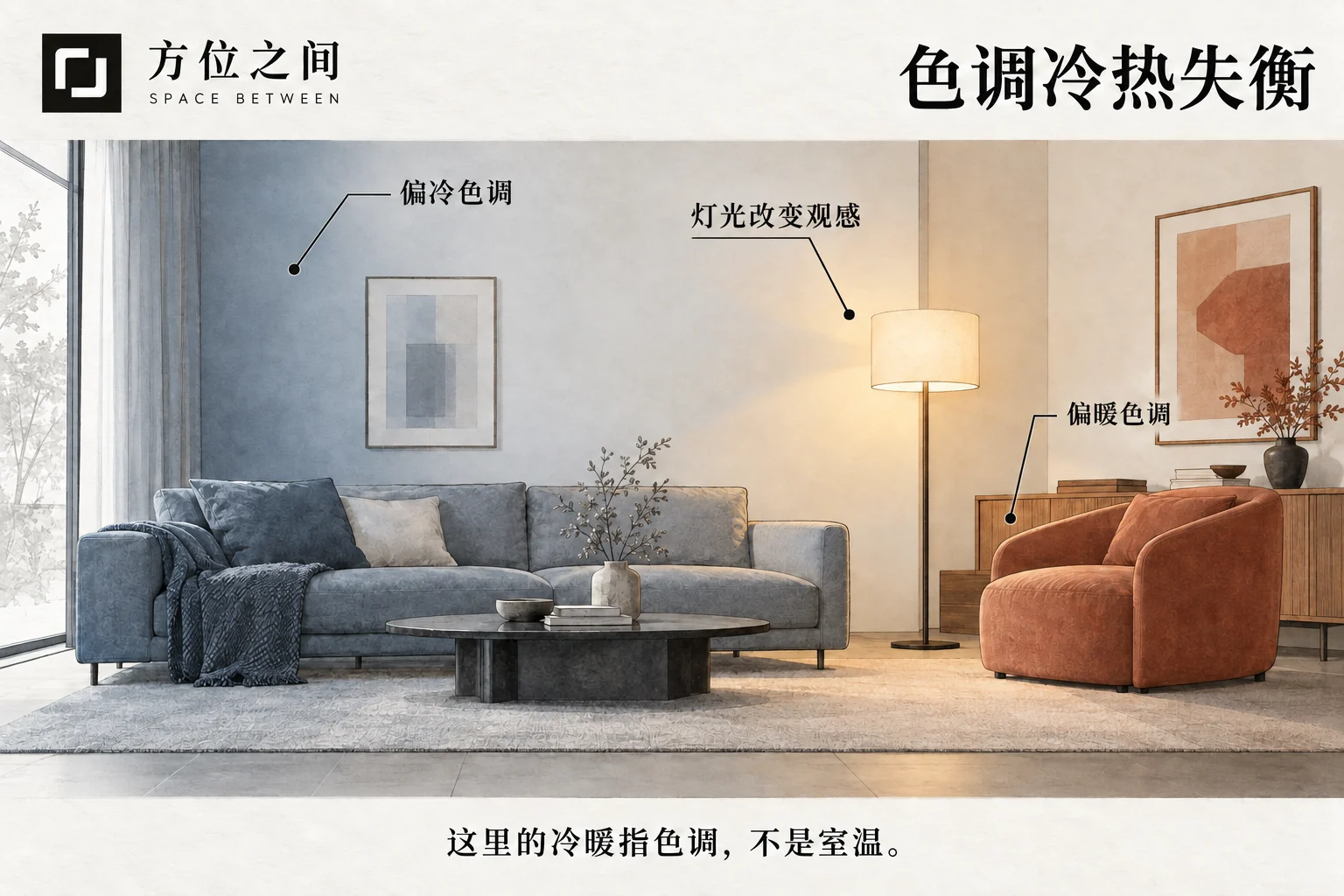
Defining features
A bluish ceiling light may share a view with a yellowish lamp, or broad cool surfaces may lack variation. Too much warm color can also obscure object colors. “Imbalance” describes a use-specific visual result, not a fixed formula.
How to recognize it
Inspect materials in daylight, then switch lighting groups individually and distinguish work, rest and transition zones. If replacing one mismatched bulb resolves the appearance, check lighting before repainting. A photograph’s white-balance error is not a site defect.
Common confusions
Light-source color temperature, object color and felt temperature are distinct; “warm white” does not inherently warm the room. Different zones may intentionally use different light. Resolve task conflicts or unwanted mixing, not all variation.
Folklore and sources
This is a modern design term without a verified ancient sha name tied to color-temperature values. Yin–yang balance can be a metaphor, but blue is not inherently ominous and yellow does not attract wealth; neither defines personality.
Traditional responses and practical improvements
Balance can mean coordinating key light colors and reducing unnecessary mixtures. Test real fixtures and material samples, preserve task color recognition and comfort, then adjust textiles. Fixture changes also require compatibility and flicker checks; color temperature is not all lighting quality.
Sources and further reading
These sources help clarify the concepts and their origins. Explaining a traditional term does not establish that it can predict outcomes.