
Defining features
In Xuan Kong, Three Jade corresponds to Lu Cun, wood and Zhen; Zhen in the east is its basic position. Annual, monthly and residential charts move it according to their rules, so an eastern base does not mean east every year. The number 3 does not stand for the third floor, three people or three plants.
How to recognize it
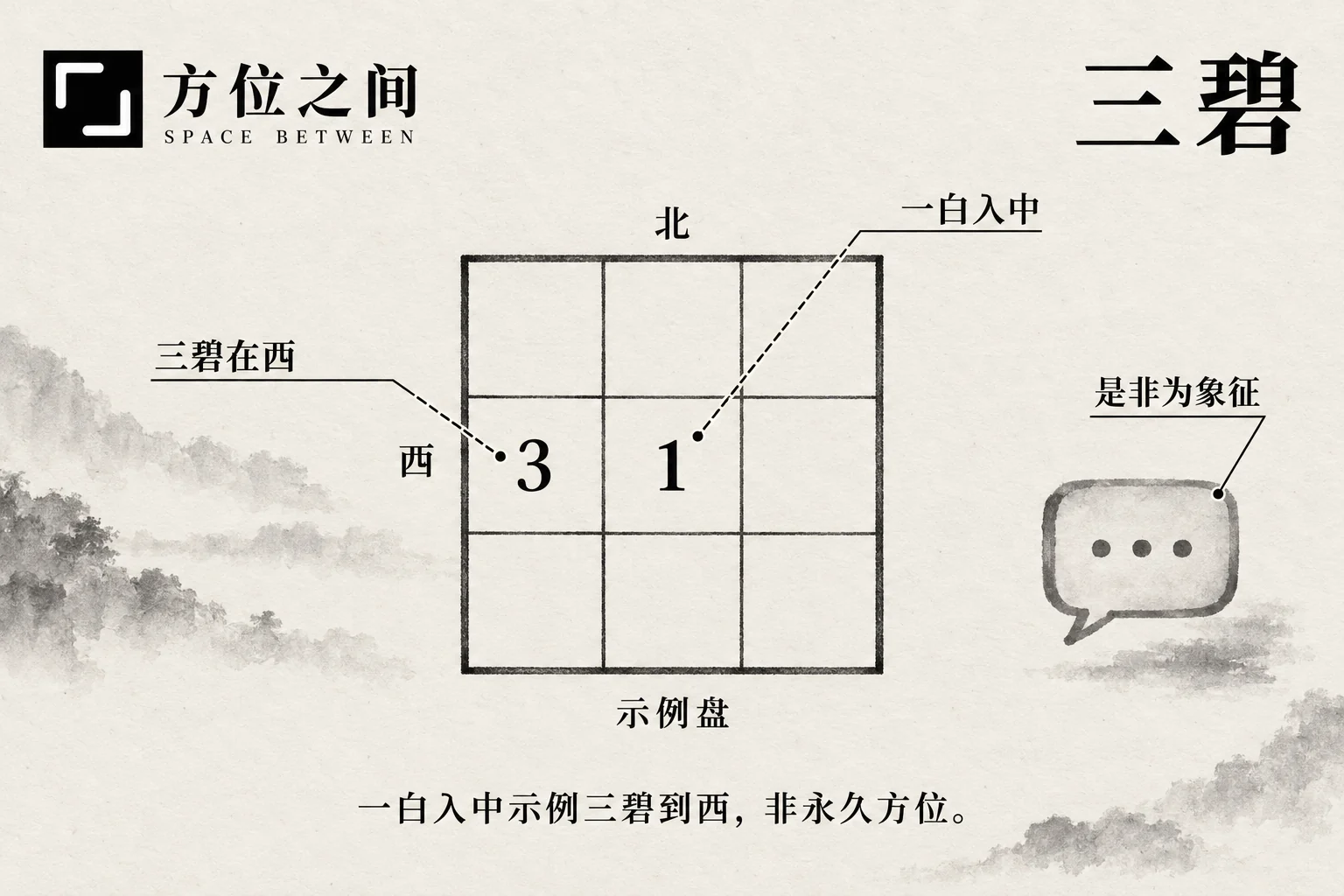
Identify the chart layer, time boundaries, center and north. In a One White center chart, Qian 2 is followed by Dui 3, placing Three Jade west. Check the entire distribution rather than moving one number alone. For an actual date, the year convention and month sequence must match the chosen method.
Common confusions
Three Jade dispute symbolism is not identical to Eight Mansions Huo Hai, a zodiac clash or an actual disagreement. Green walls, wood furniture and trees do not mean Three Jade has arrived. Symbolic elements and physical materials differ. Matching an argument to a star afterward does not rule out schedules, acoustics or communication as causes.
Folklore and sources
Volume 4 of Shen Shi Xuan Kong Xue lists Three Jade–Lu Cun–wood; volume 8 of Xieji Bianfang Shu gives annual and monthly rules. “Dispute position” is treated here as a circulating interpretation, not falsely presented as the wording of those passages. Traditional judgments also vary by period, chart layer and lineage.
Traditional responses and practical improvements
Some customs use fire-drains-wood symbolism and small red objects to express reconciliation. There is no need to burn candles or incense or create harsh light. More checkable improvements include quieter conversation, shared-space agreements, a quiet corner and addressing the dispute itself rather than blaming a resident for “bringing sha.”
Sources and further reading
These sources help clarify the concepts and their origins. Explaining a traditional term does not establish that it can predict outcomes.