
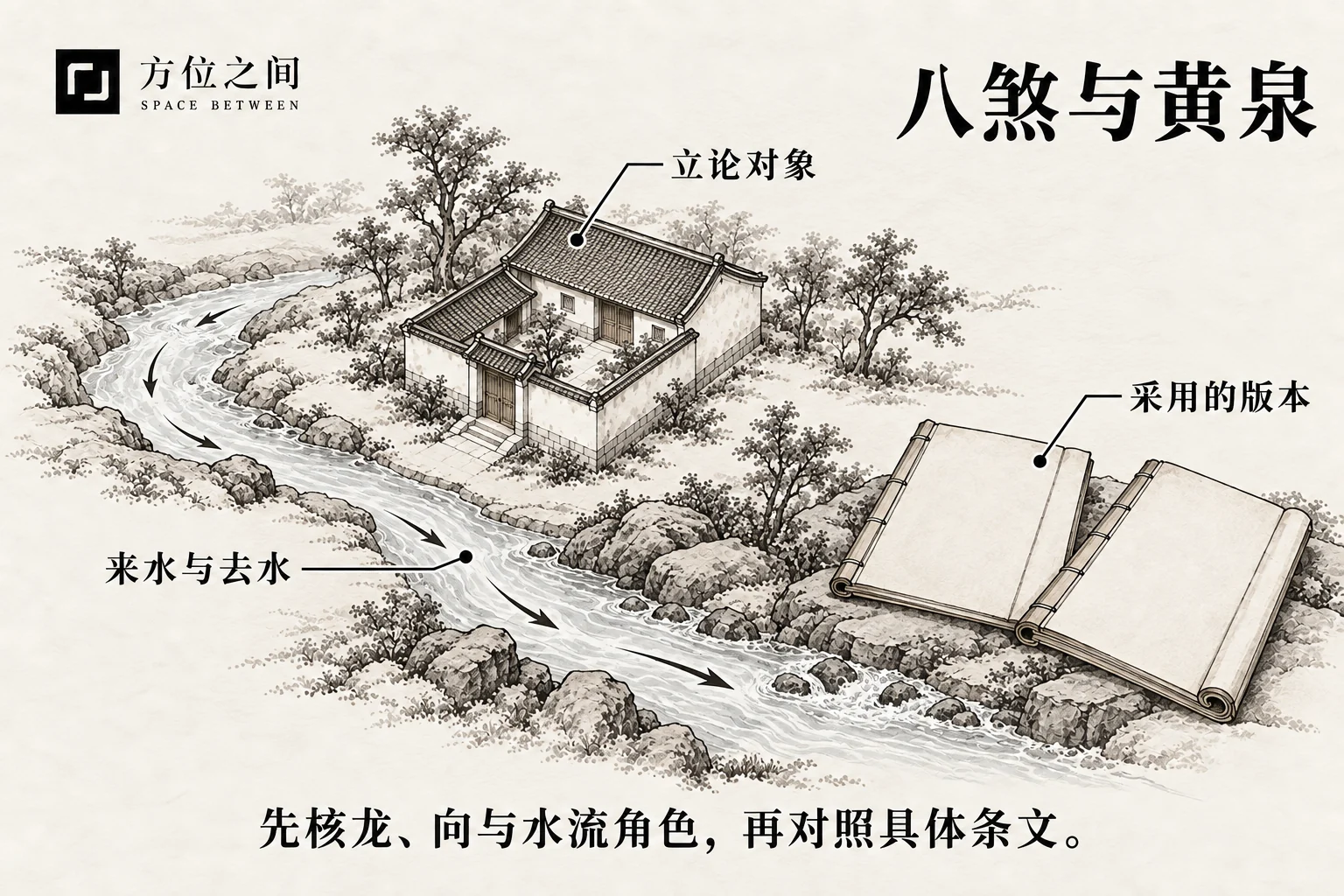
Water methods can start from different inputs
In traditional texts, long, or dragon, often denotes the course of a ridge or terrain; facing is the forward end of a defined axis. Water requires an origin, an exit and an observation point. Volume 7 of Dili Shu discusses Basha rules starting from the dragon. A directional name can therefore play different roles: an incoming ridge bearing cannot silently become a doorway bearing, nor can a drain location replace the direction of an entire watercourse. Mark each subject separately before reading the chart.
Texts disagree about incoming and outgoing flow
Huangquan is not a single taboo table shared by every school. Pingsha Yuchi Bianwei discusses Basha, Huangquan and Luma water methods, noting opposing views about incoming and outgoing water. The useful lesson is how to compare texts, rather than select the most alarming prediction: record the work, chapter, compass layer and flow conditions before comparing conclusions. Historical disagreement itself argues against treating an online mnemonic as a universal law.
A checkable exercise with flow arrows
Suppose one site plan records water entering from the northeast and leaving southwest, while another reverses the arrows. Even if both readers select the same Huangquan label, their inputs differ. Check the slope, visible flow and recording position on site, then the facing axis and compass layer. Mark unobserved underground pipes as unknown. This exercise tests consistency of the records, not the truth of predictions about fortune.
Separate cultural labels from drainage issues
A common mistake is to read a sha label as proof that a home will suffer disaster, or to treat roads, windows and indoor aquariums as interchangeable forms of water. Such substitutions require an argument; a name alone does not justify them. Keep cultural annotations separate from observations of standing water, backflow, dampness and maintenance. Drainage design and structural issues should follow site conditions and professional standards, not a water-method label.
Sources and further reading
These sources help clarify the concepts and their origins. Explaining a traditional term does not establish that it can predict outcomes.