
Yangzhai usually means a dwelling for the living. Residential feng shui discusses its surroundings, orientation and internal layout; the term does not mean a south-facing house. Start by defining the home, recording its orientation and identifying door, main room and kitchen. Traditional fortune interpretations are folklore; observe daylight, ventilation, noise and household needs separately.
Three questions to guide your reading
Define the dwelling before recording bearings and spatial relationships. These three reading paths address the object, measurements and interpretation; choose the one you need without assigning the home a score.
| Question | Record first | Then check |
|---|---|---|
| Scope: building or dwelling unit? | Site plan, floor and unit boundary | Layered apartment observations |
| Direction: facing or entrance? | Axis arrow, position and north reference | Bearing measurements and uncertainty |
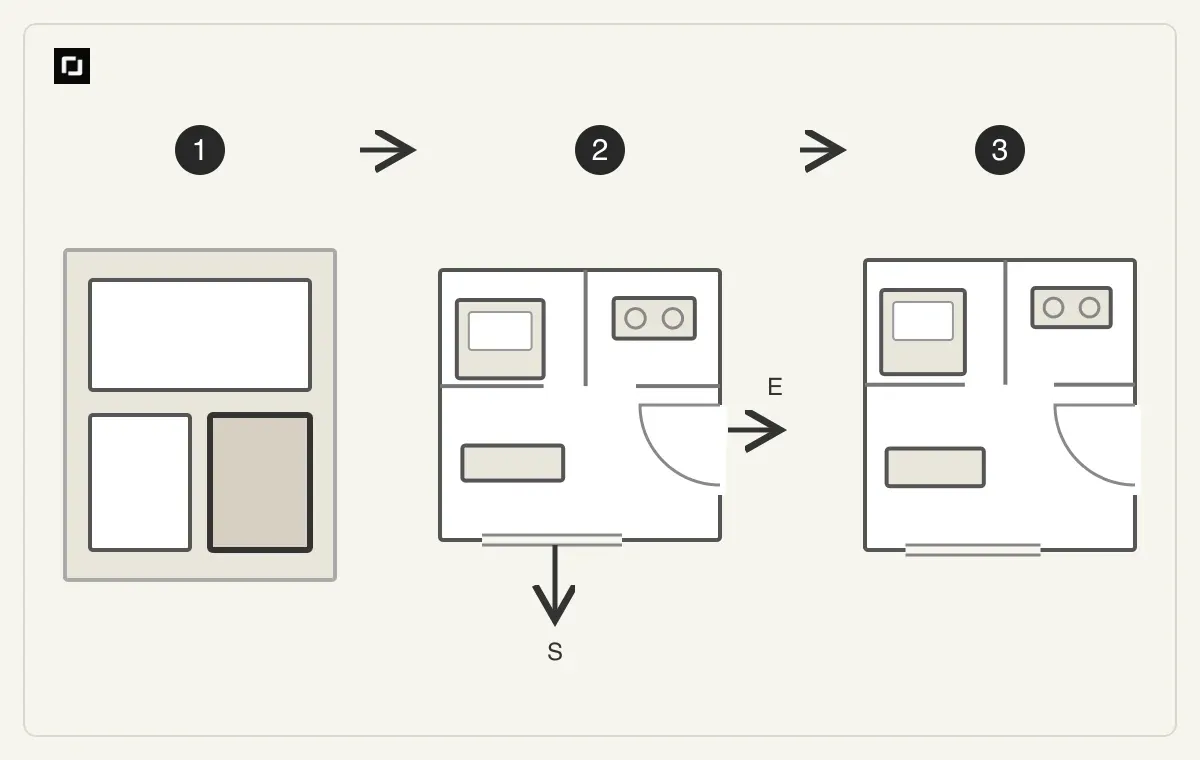
| Interpretation: what is men–zhu–zao? | Entrance, meaning of main room and kitchen location | Textual context and modern use |
Sources and instructions
What should you record first in a modern apartment?
Separate the estate, building, dwelling unit and room. Record the floor, outside obstructions, main windows, shared corridor and unit entrance, then add daylight and sound observations at different times. Two homes with the same bearing can differ because of floor level, obstructions and use. Successive courtyards in an old text are not equivalent to storeys in an apartment block.
Identify the relationship before deciding on a change
For facing doors, aligned openings, a road facing the home or a reverse curve, use the illustrated atlas to identify the actual relationship. Then record privacy exposure, colliding doors, headlights or noise if present. Start with reversible furniture, shading and circulation changes. Traditional symbolic objects are personal practices, not substitutes for structural, fire-safety or equipment checks; keep escape and ventilation paths clear.
Living room, entryway, main entrance, and balcony
When discussing Feng Shui for the living room, entryway, main entrance, and balcony, start by considering sightlines upon entry, privacy, furniture placement, and traffic flow. For instance, if the main entrance faces the balcony, clarify whether the concern is a lack of visual privacy (an unobstructed view from the door) or actual ventilation issues; then, discuss how elements like screens, cabinetry, or other arrangements might impact daily use.
Feng Shui for bedrooms, studies, and furniture placement
Bedroom Feng Shui often concerns bed orientation, placing the headboard against a window, and mirrors facing the bed; study Feng Shui often concerns desk placement. Communicate relevant preferences to co-residents and service providers, while also checking window access, storage, and traffic flow. Layout suggestions should explain the changes made rather than claiming that a specific arrangement will inevitably bring wealth, health, or academic success.
Feng Shui taboos regarding kitchens and bathrooms
Topics such as kitchen and bathroom Feng Shui—including layouts where the stove is visible from the entrance or the front door faces the bathroom—can be analyzed in terms of sightlines, workflow, cleanliness, and ventilation. Interpretations of "taboos" vary by culture and individual; if adjustments are desired, first clarify the specific concerns and the scope for modification before consulting a professional.
How to get useful advice from online Feng Shui assessments and consultations?
Share floor plans, photos of rooms, and specific areas of interest on Space Between, while clearly outlining the traditional design concepts, lifestyle needs, and structural constraints you wish to discuss. For online Feng Shui assessments, consultations, or remote floor plan reviews, first confirm with the service provider whether they offer these specific services, what information is required, and the scope of the deliverables. After receiving online recommendations, you can ask the provider to pinpoint locations on the plan and explain the rationale; note that community comments differ from paid expert advice, so the specific terms of the service provided apply.
Questions and answers
How do yangzhai, yinzhai and home feng shui differ?
In common feng shui usage, yangzhai concerns dwellings and yinzhai concerns burial sites. This guide covers homes only; home feng shui often focuses on rooms, openings and furniture. Form-based approaches examine surroundings and shapes, while directional methods use orientation, periods and specific rules. Do not merge these methods into a universal score. First decide whether you need a definition, a record of living conditions or an explanation of a particular tradition.
Does home orientation follow the entrance or balcony?
The entrance, balcony, main unit façade and building axis may face different ways. Draw separate arrows and record the object measured and whether the reference is magnetic or true north. Then choose the input required by the method being discussed. Neither a large balcony nor a busy doorway establishes a universal apartment rule, and a phone bearing cannot choose the home’s facing for you.
How do door, main room and kitchen map to a modern home?
Yangzhai Sanyao organizes dwelling analysis around door, main room and cooking space. Read zhu in its context of the principal room and building hierarchy; it is not simply the owner’s zodiac sign or whichever bedroom a modern plan labels “master”. Record the entrance, principal living space and kitchen before stating the interpretation used. Gas, electrical, extraction and structural issues depend on the actual installation and professional requirements.
Which calculations does the app provide, and how should advice be used?
Calculation mode in the Space Between app includes personal-gua calculations, Xuan Kong flying-star charts and traditional calendar/date-selection tools. They use the dates, bearings and rules supplied. Check the inputs and method first: these tools do not scan a home and automatically score its fortune, or guarantee financial, health or other outcomes.