
Choose a place where you spend time during the day, such as a desk or sofa. Check when sunlight reaches it and when it is blocked. Sun on the sill and daylight at the desk are separate observations; one midday photograph cannot describe a whole day. Record the date, position and unobserved periods so you can compare homes later.
A winter-viewing record to fill in on every visit
Use a separate entry for each home and observation point. Add a date for each return visit without overwriting earlier notes. Record direct sunlight separately from practical indoor brightness. Missing onset or end times, unsuitable weather and rooms you could not enter remain evidence gaps. Copy the blanks below to start your record.
| Record | Fill in | Missing evidence and next step |
|---|---|---|
| Date and property location | Property code ____; building/floor ____; date ____; local time zone ____; weather ____. | Identify records from other dates or show homes; mark the target home “not visited” if you did not enter it. |
| Window and indoor observation point | Room ____; window W____; outward direction/north reference ____; indoor point D____; approximate distance from window ____. | Label unverified directions or distances as estimates; return to the same position. |
| Direct sunlight: onset, end and interruptions | Observation period ____; first direct sun seen ____; last direct sun seen ____; interruptions ____; unobserved periods ____. | First and last sightings are not necessarily the actual onset and end; do not total a full day without continuous evidence. |
| Obstruction and location | Nearby building/trees ____; distant tall buildings ____; balcony depth/overhang/side wall ____; photo reference ____. | List unclear outlines or proposed buildings for verification; do not record them as confirmed built conditions. |
| Indoor use and return visit | Lights/curtains ____; desk lighting needed or glare ____; weather and time to revisit ____; information provider ____. | Personal impressions and phone readings do not establish compliance; request relevant local professional documentation when needed. |
Sources and instructions
Confirm the window orientation, then map buildings and balconies
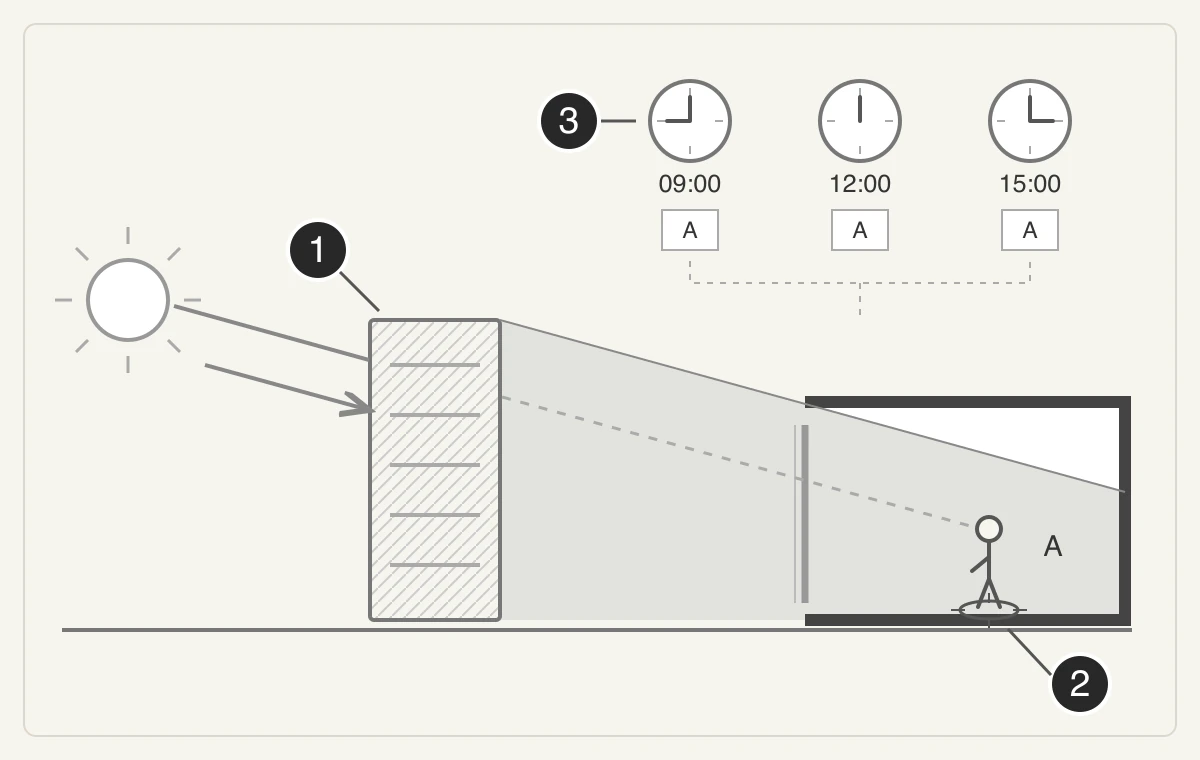
Mark the actual floor and the outward-facing direction of the target window on the plan, checking the north reference. A “south-facing home” label is not enough. At the window, record nearby and distant buildings, trees, balcony depth, overhead projections and side walls. A lower winter Sun can make obstructions in front more significant, while these features can distinguish even homes on the same floor with the same orientation. Neither one spacing measurement nor an online distance formula establishes compliance.
Record direct sunlight and indoor daylight separately
Label the sill and the place you will actually use, for example W1 for the sill and D1 for the desk. Direct-sun observations record whether sunlight reaches each point. Indoor daylight also depends on diffuse skylight, reflected light, windows and room conditions; a space can be bright without direct sun. With permission, switch off the lights and record curtains, glazing and furniture as they would be used. Sit at D1 to read or use a screen, noting any need for extra lighting or any glare. A small sunlit patch beside the window does not describe the usability of the whole room.
Use photographs and phone light readings within their limits
Keep the position, time, weather and lighting state with each photograph. For comparisons, use consistent equipment, framing and exposure where possible. Automatic exposure and HDR alter apparent brightness; phone illuminance readings also depend on the sensor, direction and calibration. Treat them as personal records. Hong Kong’s Buildings Department APP-130 distinguishes natural-light assessment from direct sunlight and specifies assessment methods; its rules cannot simply be applied elsewhere. For compliance, obtain the daylight or sunlight documentation applicable to the local project and seek professional review. Photographs, phone lux readings and a blanket “two hours of sun” rule do not establish a universal pass.
Turn missing evidence into a return-visit plan
For example, write “Home B | study D1 | clear weather, 14:00–16:00 | check whether the corner of the opposite building blocks the sun,” rather than just “poor winter daylight.” Compare homes A and B using equivalent observation points and the hours that matter to you; flag differing weather as a limit on direct comparison. In the home comparison tool, distinguish what you observed, what the provider reported and what remains unconfirmed. Use property codes and remove exact addresses when sharing publicly. Space Between’s floor-plan views help mark positions; they are not professional sunlight calculations.
How can a viewing record become useful follow-up evidence?
Fictional form example: Home A | desk P1 | clear | direct sun at 14:10 | no direct sun at 14:40 | not observed continuously between those times. This establishes two observations, not 30 minutes of continuous sunlight. At the next visit, use the same desk position and record when direct sun disappears and whether a neighboring building, balcony or clouds are involved. Use the same fields for Home B. This is a record-format example, not a property measured by us.
Questions and answers
Must a winter-solstice viewing take place on one particular day?
Use the period around the local winter solstice to plan return visits. Check the year’s astronomical calendar and local time zone rather than assuming it is always 22 December. Winter solstice falls around December in the Northern Hemisphere and June in the Southern Hemisphere, so seasonal and orientation advice cannot simply be transferred. The Sun’s path also varies with latitude; the Hong Kong Observatory shows how to explore it using a date, time and coordinates. Observations on nearby dates are useful, but are not observations on the solstice itself and do not establish a window’s minimum annual sunlight duration.
Can one sunny midday visit establish the day’s sunlight duration?
No. Schedule morning, midday and afternoon observations around the hours you will be at home. At the same point, note when direct sun appears, disappears or is interrupted by an obstruction. If there is no direct sun at 10:20 but there is at 10:40, the onset is only known to lie between those observations; do not invent 10:30. Sunlight may return after a short visit ends. Mark unobserved periods and do not treat the gap between the first and last photographs as continuous sunlight. If you cannot stay, ask the provider for a dated, timed sequence from the agreed position and record who supplied it.
What can an overcast or rainy viewing establish?
You can still check window orientation, obstruction outlines, balcony depth and the experience at each fixed point with the lights off. Clouds may explain the absence of direct sun, so it cannot by itself establish that a nearby building blocks it, or reveal sunlight duration at the solstice or the annual minimum. Record the weather and the missing clear-weather observations, then arrange another visit when direct sun can be observed. Keep sunny and overcast records separate; an automatically brightened photograph is not evidence of conditions on another day.